13: Events and CI
DEFINE EVENT handles the transitions that field clauses cannot reach: rules across two fields on the same record, reactions to a status change, side effects on a different table. This chapter adds a few events to the planning schema.
The second half turns to something SurrealKit has been quietly setting up for you since init: tests. Once the catalog does real work (COMPUTED roll-ups, UNIQUE indexes, EVENT hooks), a pull request can break those behaviours without anyone noticing in CI. surrealkit test is how you catch that before merge. We will write one small suite after the events are in place.
Events vs field clauses
| Layer | Examples |
|---|---|
DEFAULT, VALUE, ASSERT, COMPUTED | Rules that only need one field, or the record it lives on |
DEFINE EVENT | "When X changes to Y, do Z" across the whole write |
Part 5 already used an order-paid style event. Planning schemas need the same kind of thing.
Keeping activity dates sane
Add database/schema/events_activity.surql:
DEFINE EVENT activity_end_after_start ON activity
    WHEN $event IN ["CREATE", "UPDATE"]
        AND $after.end < $after.start
    THEN {
        THROW "Activity end must be on or after start";
    };
You could try this as an ASSERT ($after.end > $this.start), and it would mostly work on update, but it gets awkward on create, before $this is fully wired up. An EVENT sees $before and $after for both CREATE and UPDATE, so it does not run into that problem.
If you try it out, you will not see this event's message yet. The COMPUTED duration field from part 8 is evaluated during the write as well, and end - start fails first when end is earlier than start:
UPDATE activity:concrete SET end = start - 1d;'Failed to compute: "2026-12-29T03:37:34.173765Z - 2026-12-30T03:37:34.173765Z", as the operation results in a negative value.'The bad write is rejected either way, but the error says nothing about activities. To let the event give the clearer message, make duration handle the case itself:
DEFINE FIELD duration ON activity COMPUTED IF end >= start { end - start };Stopping an activity depending on itself (optional)
DEFINE EVENT no_self_dependency ON depends_on
    WHEN $event = "CREATE" AND $after.in = $after.out
    THEN {
        THROW "An activity cannot depend on itself";
    };
This only catches the one-step case. Longer cycles (A depends on B, which depends on A) usually need application logic or a batch job to find. Treat EVENT hooks as cheap invariants on the hot path, not a general-purpose validator.
Logging when a milestone's activity finishes
When an activity's progress reaches completion, you might want to notify something downstream. In a teaching schema, an audit record is a reasonable stand-in:
DEFINE TABLE activity_audit SCHEMAFULL;
DEFINE FIELD activity ON activity_audit TYPE record<activity>;
DEFINE FIELD note ON activity_audit TYPE string;
DEFINE FIELD at ON activity_audit TYPE datetime DEFAULT time::now();

DEFINE EVENT log_activity_complete ON activity
    WHEN $event = "UPDATE"
        AND $before.progress < 1.0
        AND $after.progress >= 1.0
    THEN {
        CREATE activity_audit SET
            activity = $after.id,
            note = "Activity marked complete";
    };
EVENT bodies run as part of the statement that triggered them: the activity_audit record exists as soon as the UPDATE returns, and a THROW inside an event (as in the two events above) rejects the whole write. DEFINE EVENT … ASYNC is the form that runs later, outside the triggering statement, and that is where you need to design for retries and make failures visible.
Keep events with the schema
DEFINE EVENT belongs next to the tables it touches, or in a shared database/schema/events.surql if you would rather group them. Either way, SurrealKit applies events on sync or rollout start like any other definition. Removing one is destructive, so that waits for rollout complete, once nothing depends on it any more.
Why SurrealKit has a test command
Schema in git is only half the story. You also want a machine to prove that the catalog still behaves the way the course (and your app) expect, such as:
Does
milestone.progressstill average the linked activities?Does a bad date still get rejected by the event you just added?
Did someone remove a
UNIQUEindex by accident?
surrealkit test answers those questions against a throwaway database: apply the schema, run suite files under database/tests/suites/, fail if a case breaks. It is the CI twin of local sync - fine to run often, never a substitute for rollouts on shared data.
A first test suite
Init already left database/tests/suites/smoke.toml. Add a second suite beside it at database/tests/suites/milestone_rollups.toml:
name = "milestone_rollups"
tags = ["computed"]

[[cases]]
name = "mean_progress_matches_activities"
kind = "schema_behavior"
actor = "root"
setup_sql = [
  "CREATE project:test SET name = 'Test';",
  "CREATE activity:a SET name = 'A', start = time::now(), end = time::now() + 1d, progress = 0.5;",
  "CREATE activity:b SET name = 'B', start = time::now(), end = time::now() + 2d, progress = 1.0;",
]
action_sql = "CREATE milestone:m SET project = project:test, activities = [activity:a, activity:b], name = 'M1';"
verify_sql = "SELECT VALUE progress FROM ONLY milestone:m;"
expect_success = true
assertions = [
  { path = ".", equals = 0.75 },
]
Run it with:
surrealkit test --user root --pass secret --ns main --db mainTest run: PASS (187ms)
Summary
- suites: 2 total, 0 failed
- cases : 2 total, 2 passed, 0 failedSurrealKit loads every *.toml under database/tests/suites/ (including the default smoke suite, which is the second suite in that count). test spins up an ephemeral database per suite, applies the schema, runs your seed files, runs the cases, and fails CI the moment an assertion breaks. Because it seeds, expect the schema-apply and seed output to repeat once per suite before the summary; --no-seed skips that step if a suite would rather start from an empty database. Good early targets:
COMPUTEDroll-ups, so a schema edit cannot quietly change the numbersUNIQUEindexes, to confirm they are actually thereEVENTdefinitions, to confirm they apply without error (and later, that they fire when you write the right data)Permissions and
DEFINE APIsurfaces, if you add either later
See testing with SurrealKit for the rest of the options.
A CI sketch
# .github/workflows/schema.yml (illustrative)
- run: surrealkit test
  env:
    SURREALDB_HOST: http://localhost:8000
    SURREALDB_NAMESPACE: ci
    SURREALDB_NAME: planning
Pair test with a review of the rollout plan on any pull request that touches database/schema/. Two more checks catch a schema change that nobody planned a rollout for:
surrealkit rollout lint, with no id, checks every manifest and how they chain, without a database. It fails whendatabase/schema/has changes that no rollout plans yet.schema_from = "both"under[defaults]indatabase/tests/config.tomlruns every suite twice: once on a database built withsync, and once on a database built by replaying every rollout from empty, the way production got its schema. A parity check runs first and lists any definition on which the two disagree.
# database/tests/config.toml
[defaults]
timeout_ms = 10000
schema_from = "both"
Checkpoint
DEFINE EVENTfor date validation, edge-case rules, and completion side effectssurrealkit testto guard against regressionsEvents and indexes versioned right alongside the tables
Next: capstone, aligning with the docs sample, rollout baseline, and running schema across environments.
THE PLATFORM
Everything an application and its agents know. Five surfaces, one engine.
Database
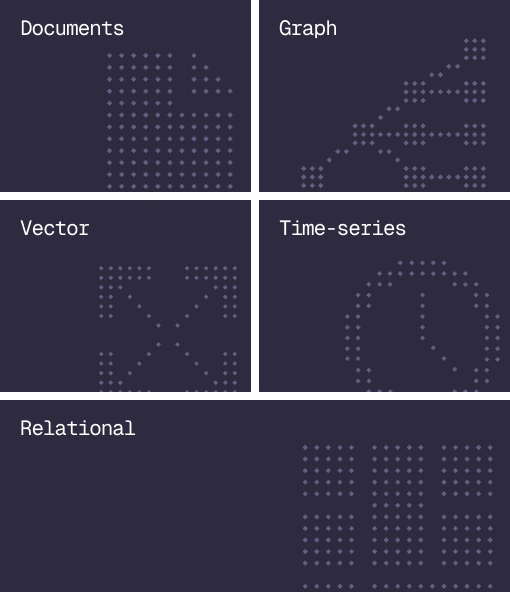
Document, graph, vector, time-series and relational in one engine.
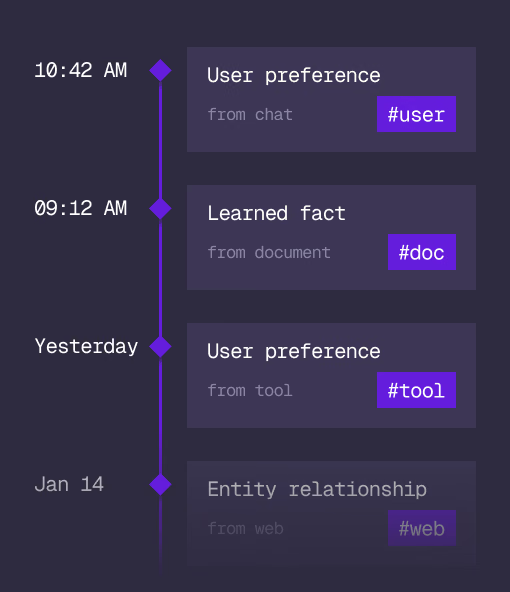
Agent Memory
What an agent learns, with its source and its time, in the same engine.
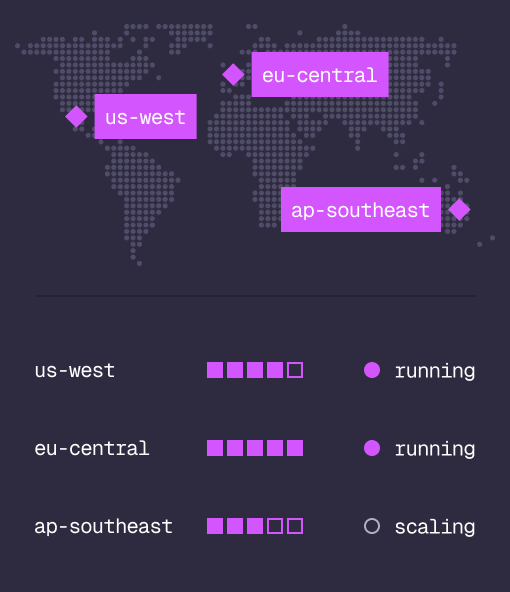
Cloud
Managed clusters in the regions you choose, scaled on demand.
Studio
Query, explore and design the schema from the browser.
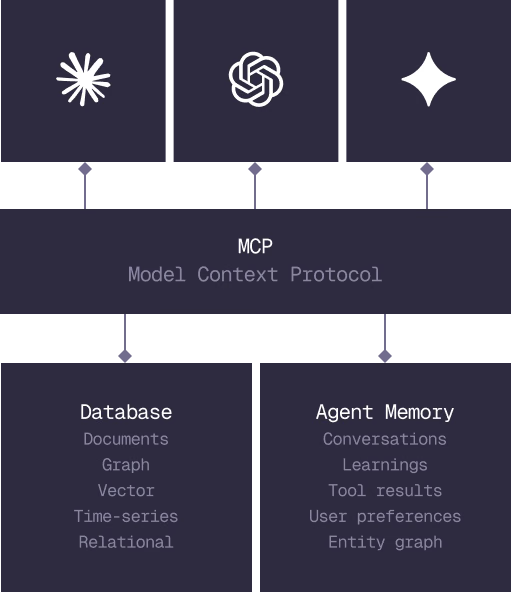
MCP
Every model that speaks MCP reaches the database and the memory directly.
IN PRODUCTION
Trusted at scale. Samsung, Nvidia, Verizon, Tencent, and Walmart run on SurrealDB.
14,000+
Developers building on SurrealDB Cloud
4M+
Developers building on SurrealDB worldwide
FROM THE TEAMS
SurrealDB gives us a foundation where we can unify semantic search, knowledge graphs, and AI-driven decision making without stitching together multiple systems. Collapsing responsibility into SurrealDB has become our default engineering posture.
VP of Engineering, Later