WHY AGENTS FORGET
Agents fail because of context, not models.
An agent's only built-in memory is the context window, and it is wiped when the session ends. Everything it worked out, it works out again - the same files re-read, the same dead ends re-tried, the same corrections re-typed by whoever is supervising it.
Same model, same prompt, same tools. The only difference is whether the last session survived - and, because every recalled fact cites the turn it came from, whether the agent can show you why it believes it.
HOW IT WORKS
Every turn: read → think → write
Agents operate in a continuous cycle: read context, reason over it, and write results back. Agent memory keeps the entire loop inside one engine and one transaction boundary.
Read
SurrealQL
Multi-model query
Graph
Vector
Temporal
Unified result set
Pull the whole context in one round trip
Graph traversal, vector search, and temporal facts resolve in a single SurrealQL statement. No fan-out across a vector store, a graph store, and a row store, and no application-side join to reconcile them.
One statement, one round trip
Eight retrieval signals fused in one ranker
Per-verb grants applied at the engine, deny by default
Think
Result set
Multi-model query output
Documents
Relations
Vectors
History
Complete context
The agent reasons over complete context
Documents, relationships, embeddings, and history arrive together rather than as separate results the agent has to stitch. What comes back is the slice that matters for this turn, with the sources attached.
Documents, relations, and embeddings in one payload
Superseded facts marked, not silently dropped
Every answer carries the exact sources behind it
Write
BEGIN TRANSACTION
ACID transaction boundary
Update
Create
Trigger
COMMITTED
Persist the turn in one ACID transaction
Decisions, entity updates, and events commit together or not at all. There is no window where the vector index has the embedding but the graph has not yet learned the fact.
One ACID transaction per fact
No partial writes, no cross-store drift
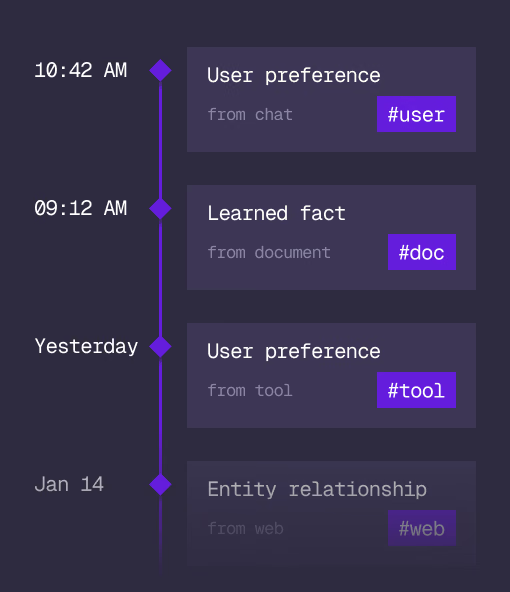
Tri-temporal history recorded on every change
FOR DEVELOPERS
Drop it in beneath your agent.
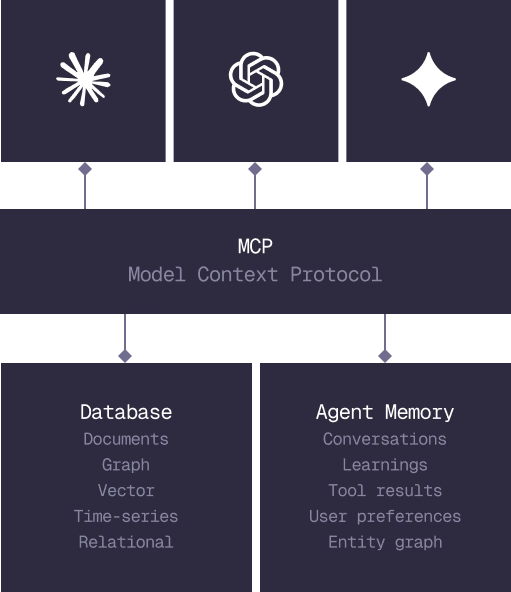
Agent memory doesn't replace your agent framework or manage the context window - it's the memory layer you add underneath. Connect over MCP from any client, the TypeScript SDK, the CLI, or the REST API, with adapters for LangChain, OpenAI Agents, the Vercel AI SDK, and n8n. Then it's two calls: remember and recall.

One Rust binary with MCP built in - seven tools: remember, recall, context, reflect, forget, upload, and inspect. No Python runtime, no sidecars.
ONE SUBSTRATE
One engine, not a pile of stores.
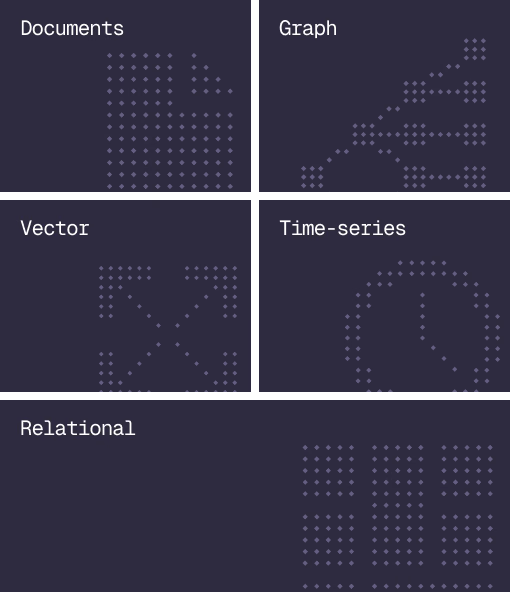
Most memory layers stitch a vector store, a graph store, and a row store together with glue code, and inherit every seam - no cross-store transactions, drift, separate scaling. Agent memory is one SurrealDB engine: graph, vector, document, and time in a single ACID transaction, no plumbing to run.
Before - Multiple stores
Vector
database
Proprietary API
Full-text search
database
Search DSL
Time-series
database
InfluxQL / Flux
Document
database
SQL / MQL
Graph
database
Cypher / Gremlin
Relational
database
SQL
After - Agent memory on SurrealDB
SurrealQL
PRICING
Pick a plan, start in a week's free trial.
Three self-serve plans priced on the tokens your agents actually use, and an enterprise package for larger allowances and single-tenant isolation. SurrealDB, the engine underneath, is open source and free to self-host.
One-week free trial
Full memory layer, no feature gates
MCP, SDK, CLI, and REST
Scales to zero between sessions
Agent memory Lite
$29
/mo
The entry rung of the ladder - the full memory layer, sized for getting started.
What you get
1 million tokens per month included
One-week free trial
Knowledge graph, provenance, and tri-temporal memory
Hybrid retrieval (vector + BM25 + graph)
MCP server, TypeScript SDK, and CLI
Plus
Community support
Usage beyond the included tokens is charged at the published overage rate for your plan. Enterprise allowances, single-tenant deployments, and custom SLAs are agreed with sales.
INTEGRATIONS
Connects to everything you already use
MCP clients, the TypeScript SDK, the CLI and REST API, agent frameworks and automation platforms - the same wall as the product's own connect surface.
SDKs & API
Talk to a Context directly from your own code.
Agent memory CLI
Connect via CLI
JavaScript
Connect via SDK
Python
Connect via SDK
Go
Connect via SDK
Swift
Connect via SDK
Kotlin
Connect via SDK
Haskell
Connect via SDK
Elixir
Connect via SDK
Dart
Connect via SDK
REST API
Connect via API
Agents & coding tools
Connect your AI agents and coding assistants for persistent memory.
Claude Code
Connect via MCP
Claude Desktop
Connect via MCP
Cursor
Connect via MCP
OpenAI Codex
Connect via MCP
OpenClaw
Connect via MCP
Hermes
Connect via MCP
VS Code
Connect via MCP
Windsurf
Connect via MCP
Zed
Connect via MCP
Any MCP client
Connect via MCP
Frameworks
Wire a Context into your agent framework of choice.
LangChain
Connect via package
OpenAI Agents
Connect via package
Vercel AI SDK
Connect via package
EveJS
Connect via package
Cloudflare
Connect via MCP
TanStack AI
Connect via MCP
Mastra
Connect via MCP
Automation platforms
Give your automation workflows access to a Context's memory.
n8n
Connect via node
Zapier
Connect via MCP
Messaging
Bring a Context's memory to the channels you already message on.
Coming soon
Telegram
Coming soon
Facebook Messenger
Coming soon
SMS / RCS
Coming soon
Connectors
Sync memory to and from the tools and data platforms your team uses.
SurrealDB
Coming soon
Slack
Coming soon
Notion
Coming soon
Google Drive
Coming soon
GitHub
Coming soon
Linear
Coming soon
Confluence
Coming soon
Databricks
Coming soon
Snowflake
Coming soon
GET STARTED
Give your agents a memory that lasts
Durable memory, trustworthy recall, and a knowledge graph - one system you buy, secure, and audit once. Built on SurrealDB.
SOC 2 Type 2
GDPR
Cyber Essentials Plus
ISO 27001
Every plan starts with a one-week free trial · self-serve from $29 a month.
FREQUENTLY ASKED QUESTIONS