



















01 |ANATOMY
The six parts of an agentic system. One decides what the model knows.
Agent Memory is the bottom four: the context layer, memory, the knowledge graph and storage.
02 |TYPED MEMORY
Conversations become typed facts. Reconciled in code, so the outcome is repeatable.
Agent Memory turns conversations and documents into typed facts about entities. Every fact is one of three primitives: an attribute (a key and value on an entity), a relation (a directed link between two entities) or an action (something an entity did, and when). Each fact records when it was true in the world, when it was learnt, its source and its confidence.
Memory is organised into six categories. Each fact is tagged identity, knowledge or context, and conversations, instructions and uncertainties are kept as records of their own.
Episodic
Identity
Knowledge
Context
Instructions
Uncertainty
03 |RECONCILIATION
Reconciled before it is stored. Four rules shape the outcome.
Decided in code
Reconciliation decisions are made in code, not by a model, so they are repeatable.
Contradictions stay visible
When sources of different kinds disagree, the conflict is recorded as uncertainty for review rather than resolved silently.
Confidence is respected
A value the model scores below the confidence floor, or below the current value, is held as uncertainty instead of replacing it.
Matched by name
Entities are matched by name, so differently named references to the same entity are not merged automatically. This is a stated trade-off.
04 |KNOWLEDGE GRAPH
One graph for conversations and documents. Cited back to the source passage.
One entity and relation graph is shared by conversations and documents. Documents are parsed (PDFs, and images, audio and video), chunked, extracted, linked by section and keyword, and cited back to the source passage.
05 |TEMPORAL MEMORY
Three clocks. A changed fact is closed, never overwritten.
System time, known time and valid time each answer a different question, and each is queryable on its own.
System time
Known time
Valid time
Supersession, not overwrite
Forget and purge
Visible to the next read
06 |PROVENANCE
Every answer walks back to its source. Its traces are stored as data.
Provenance is recorded on the facts themselves and in traces written to the tenant's own database, so any answer can be reconstructed from the records behind it.
A source on every fact
Three kinds of trace
Kept in the tenant's database
An audit-event stream
07 |RECALL
Four tiers, one trace. Seven signals, one ranking.
A recall request goes through a four-tier router. The cheapest path that can answer is taken: a repeated chat question whose facts have not changed reuses the earlier answer.
The tiers are numbered by cost. The answer cache, tier 2, is checked first, and tier 1's reads then seed the ranking.
Tier 1 is never terminal
Entity-aware invalidation
Escalation
Scores on the trace
RANKING
Seven signals, one score. Each result explains its score on the trace.
Vector
Finds passages, turns, audio and images by meaning, through embeddings.
Lexical
Matches keywords, so exact terms survive paraphrase.
Graph
Follows relationships between entities to related facts, even when their wording differs.
Section links
Section embeddings and links between documents surface related sections of related documents.
PageRank
A graph walk biased towards the query's seed entities, scored as one feature of the ranking.
Geo
Within-radius and inside-polygon filters compose with the other signals, and nearer results score higher.
Trace features
The history of what proved useful feeds back into the ranking.
08 |SUBSTRATE AND TENANCY
One instance, one transaction per fact. Isolation in two levels.
One SurrealDB instance
One transaction per fact
Two isolation levels
Contexts
Scope
Grants only narrow
THE PLATFORM
Everything an application and its agents know. Five surfaces, one engine.
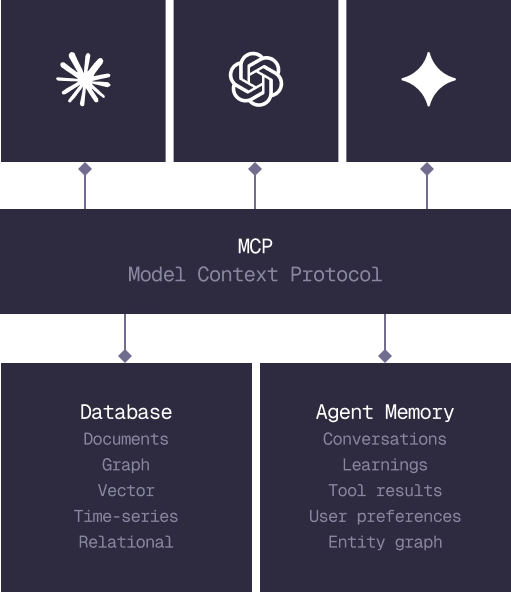
Database
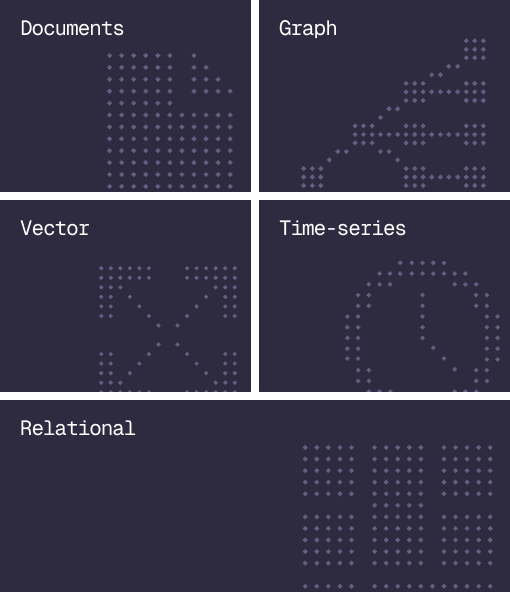
Document, graph, vector, time-series and relational in one engine.
Agent Memory
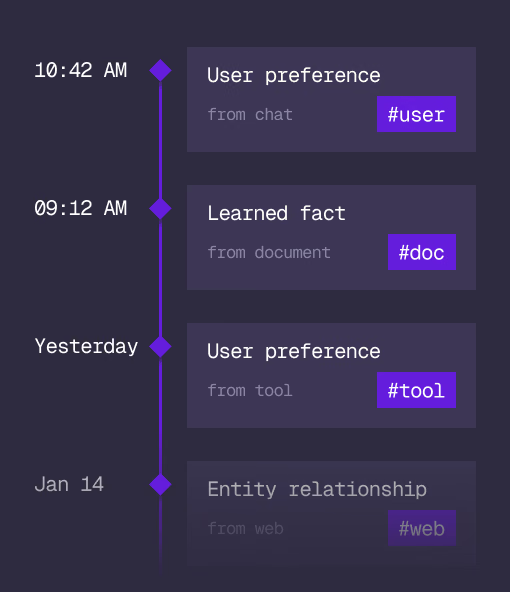
What an agent learns, with its source and its time, in the same engine.
Cloud
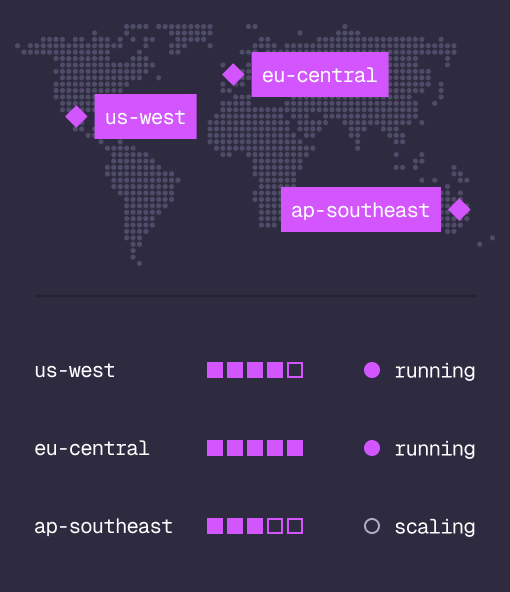
Managed clusters in the regions you choose, scaled on demand.
Studio
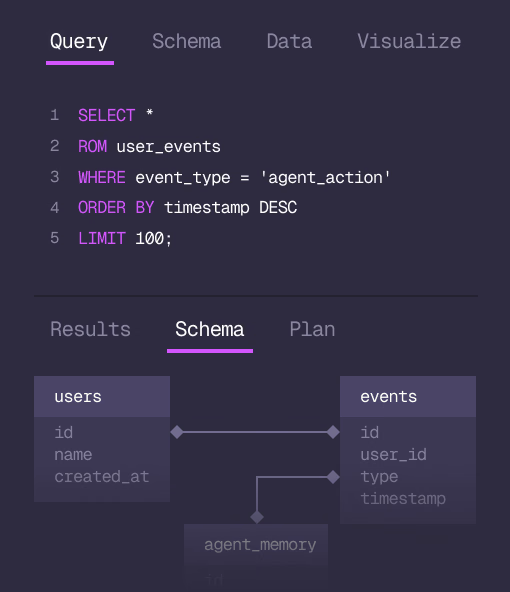
Query, explore and design the schema from the browser.
MCP
Every model that speaks MCP reaches the database and the memory directly.
IN PRODUCTION
Trusted at scale. Samsung, Nvidia, Verizon, Tencent, and Walmart run on SurrealDB.
14,000+
Developers building on SurrealDB Cloud
4M+
Developers building on SurrealDB worldwide
FROM THE TEAMS
SurrealDB gives us a foundation where we can unify semantic search, knowledge graphs, and AI-driven decision making without stitching together multiple systems. Collapsing responsibility into SurrealDB has become our default engineering posture.
VP of Engineering, Later
GET STARTED
Build with Agent Memory. Create a context in Studio, then use it through the REST API, the Python and TypeScript SDKs or the MCP tools.