


















New

Vector RAG that actually understands context

Register now

1/2

Glow

SurrealDB vs. Neo4j

SurrealDB is built for live, large-scale application data. Neo4j is built for traversal-heavy graph workloads at modest scale.

Neo4j is optimized for read-heavy graph workloads and traversal-centric analysis. SurrealDB is designed for continuously updated graphs and multi-modal workloads at scale.

Built for live workloads

SurrealDB supports mixed read/write workloads and real-time updates for constantly changing operational systems.

Built for live workloads

Lower cost at scale

Efficient storage usage through auto-sharding reduces infrastructure costs.

Lower cost at scale

Multi-model by design

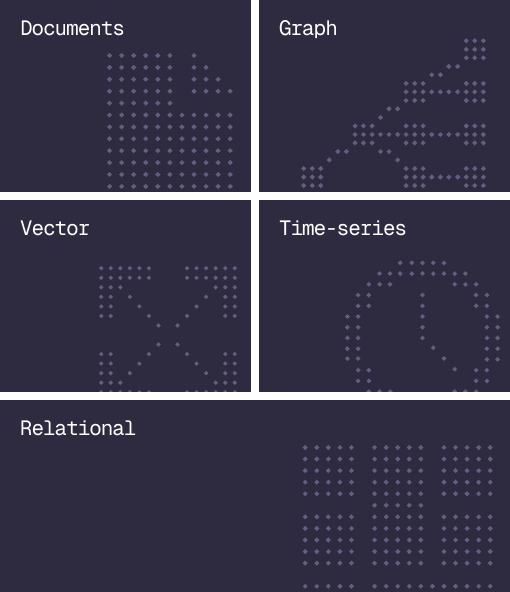
Graph, document, vector, geospatial, full-text, and temporal data in one engine.

Multi-model by design

Designed for horizontal scale

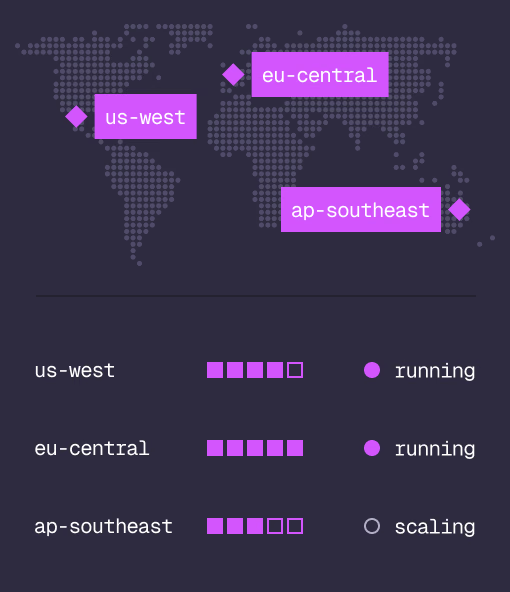
SurrealDB distributes data and compute across nodes and has multi-writer capabilities.

Designed for horizontal scale

Trusted for live application data at scale

Enterprise teams use SurrealDB for continuously changing datasets where correctness, performance, and scale matter.

SurrealDB vs. Neo4j

at a glance

AI applications need live data, continuous real-time updates, and complex retrieval queries, pushing graph-only read-optimized systems to their limits.

Neo4j suits mostly static graphs, while SurrealDB is built for constantly changing, high-volume, multi-model workloads.

Business-critical capabilities

Neo4j

Graph-native database optimised for traversal. Cache-dependent performance. Performance degrades under sustained write-heavy workloads.

SurrealDB

Designed for continuously updated data with native graph, document, vector, full-text, and temporal querying.

Platform openness and composability

Neo4j

Graph-first engine. Non-graph typically lives elsewhere, requiring duplication and ETL.

SurrealDB

Single engine and query language across all data models.

Cost and performance

Neo4j

Based on public pricing, enterprise cloud deployments are ~2-3x more expensive. Strong performance requires the working graph to fit in memory.

SurrealDB

Lower cost due to open source model and efficient hardware utilisation. Compute can be scaled horizontally to handle heavier workloads.

SurrealDB is built for enterprise reliability and live data

Designed for continuous writes

Neo4j relies on an in-memory page cache. Writes replace affected pages in cache, causing churn and eviction, degrading performance.

SurrealDB is built for mixed read/write workloads, with a write path designed for concurrent updates across nodes and storage optimised for sustained write throughput rather than cache residency.

Scales beyond memory limits

Neo4j performance assumes the working dataset fits in memory on a single machine; when it does not, performance degrades.

SurrealDB is designed to operate beyond single-node memory limits and handle large, evolving datasets.

No hard cluster limits

Neo4j clustering is limited to a single primary writer, and scales reads through reader nodes with full replicas.

SurrealDB is multi-master and designed for large distributed deployments without single-writer leadership or full-replica scaling constraints.

Enterprise takeaway

Neo4j is best suited for slowly changing analytical graphs.

SurrealDB is designed for live, large-scale production systems such as AI agents.

SurrealDB is open and interoperable by design

One platform instead of many

Neo4j is graph-native. Documents, vectors, and full-text search typically require separate systems, leading to duplication and complex pipelines.

SurrealDB unifies graph, document, vector, full-text, and temporal data in a single engine.

Unified query execution

Neo4j executes queries as staged index lookups and graph traversals with optimisation limited to the graph domain.

SurrealDB executes vector similarity, full-text search, document filtering, and graph traversal within a single unified query plan.

Control without lock-in

Neo4j's advanced capabilities and horizontal scaling are tied to proprietary enterprise offerings.

SurrealDB provides the same core capabilities in open source, with full control over deployment and architecture.

Platform takeaway

Neo4j excels at graph traversal and pattern matching, but typically operates as part of a broader multi-database architecture.

SurrealDB reduces system sprawl, operational overhead, and data inconsistency by collapsing multiple databases into one unified platform.

SurrealDB & Neo4j compared

A direct comparison of capabilities, architecture, and deployment options.

Business model

Neo4j

Largely proprietary, with most production-grade features gated behind a commercial agreement.

SurrealDB

Open source and available for use.

Availability

Neo4j

Runs locally, on-premises, and on all major public clouds, either self-managed or via the Neo4j Aura managed service.

SurrealDB

Runs locally, on-premises, and on all major public clouds. Deployable as embedded, single-node, or distributed.

Architecture

Neo4j

Graph-native database with tightly coupled storage and compute. Optimised for read scaling with a single write leader. Performance depends on the in-memory page cache, with higher latency when data exceeds memory. Heavy writes cause cache churn and coordination overhead.

SurrealDB

Distributed, multi-model database with decoupled query and storage layers. Uses distributed key-value stores in clustered mode to support horizontal scaling while remaining efficient on a single node. Designed for heavy read and write production workloads.

Scale

Neo4j

Scales reads via replicas. Write scalability is limited to a single leader. Data is fully replicated to each read node, increasing memory requirements and constraining practical dataset size.

SurrealDB

Horizontally scalable for both reads and writes by adding query nodes and scaling the distributed storage layer. Designed to avoid manual sharding and to support large datasets and high write throughput.

Resilience

Neo4j

Loss of the primary writer causes temporary unavailability until leader re-election completes.

SurrealDB

Distributed deployment provides high availability and fault tolerance. No single node failure causes system unavailability.

Transactional consistency

Neo4j

ACID transactions on the write leader, clustered reads are replica-lagged unless causal consistency is enforced via bookmarks.

SurrealDB

Supports distributed ACID transactions with strong consistency guarantees.

Models

Neo4j

Single-model graph database focused on nodes, relationships, and properties.

SurrealDB

Native multi-model database supporting document, relational, graph, key-value, time-series, vector, and geospatial access patterns in a single system.

Pricing

Neo4j

Enterprise cloud pricing is $146 per GB of memory per month. A 128 GB deployment costs $18,688 per month. Scaling requires read replicas that each carry a full copy of the data, causing costs to grow rapidly with dataset size and throughput.

SurrealDB

At an equivalent memory footprint, a cloud deployment is 62.4% cheaper than Neo4j. SurrealDB's distributed storage engine enables auto-sharded distributed storage and regularly achieves 70-80% compression. Costs scale roughly linearly with data volume and workload growth.

Reflection subtle

LET'S GOOOO

Ready to build your solution?

The multi-model database for AI agents. Unify data. Unlock intelligence. Scale anywhere.