








CAPABILITIES
Security and portability, edge to cloud. Built for distributed industrial environments.
Memory-safe and fast
Written in Rust, with performance on a par with C and C++.
Edge and embedded
On-site, in-browser via WebAssembly or on field-deployed systems.
Vectors and knowledge graphs
Embedding retrieval and entity relationships in the same engine.
Cloud to edge to browser
Cloud service, self-hosted, embedded or in-browser, from one codebase.
SEE IT IN ACTION
Detect anomalies in sensor data. Time-series queries that flag deviations before they cause failures.
Readings from the last hour compared against the rolling 24-hour average.
USE CASES
Core use cases. How energy and manufacturing teams apply SurrealDB.
Predictive maintenance
Wear prediction and fault detection running in edge-based instances.
Energy load forecasting
Embedded AI logic and vector search for real-time grid optimisation.
Digital twin modelling
Production lines, energy assets and supply networks as living graphs.
Supply chain visibility
Native graph traversal for traceability and root-cause analysis.
Cybersecurity risk modelling
Anomaly detection across energy infrastructure and smart metering.
Time-series and history
Longitudinal analysis, and compliance audits through point-in-time queries with VERSION on a versioned storage engine (experimental).
WHY SURREALDB
Why decision makers choose SurrealDB. The advantages that matter in industrial settings.
Horizontal scalability
Petabytes of sensor and telemetry data across plants and control units.
OLTP, BaaS and real-time in one
Transactional workloads and AI pipelines served from the data layer.
Graph capabilities
Multi-relational modelling for supply chains, risk and compliance tracing.
Time-series and point-in-time
Ingest from IoT sensors and SCADA, then run point-in-time queries with VERSION on a versioned storage engine (experimental).
Low operational overhead
One engine to run, for private modernisation and public transformation alike.
Your questions,answered
THE PLATFORM
Everything an application and its agents know. Five surfaces, one engine.
Database
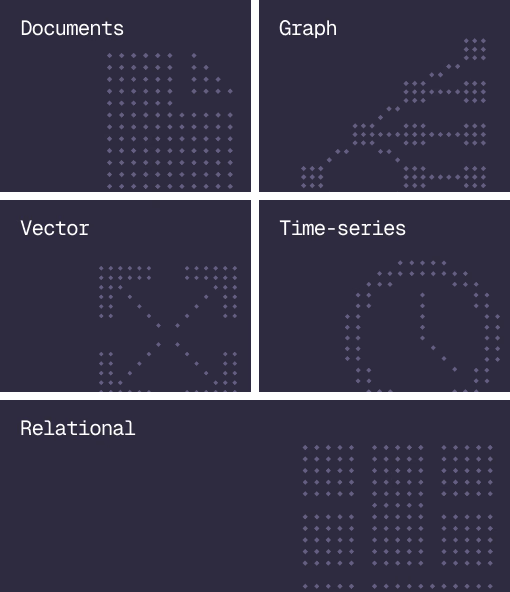
Document, graph, vector, time-series and relational in one engine.
Agent Memory
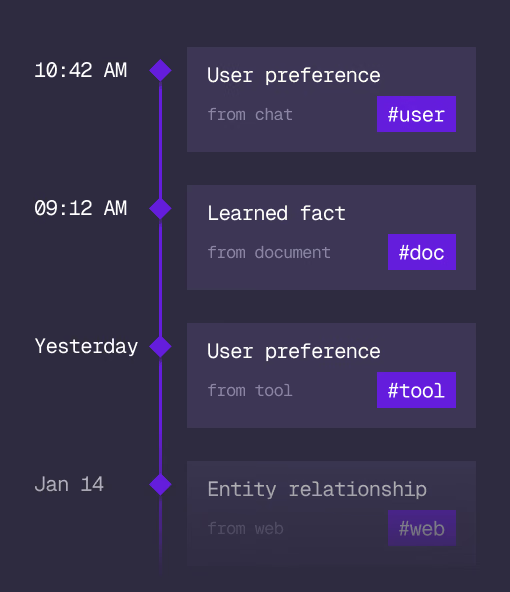
What an agent learns, with its source and its time, in the same engine.
Cloud
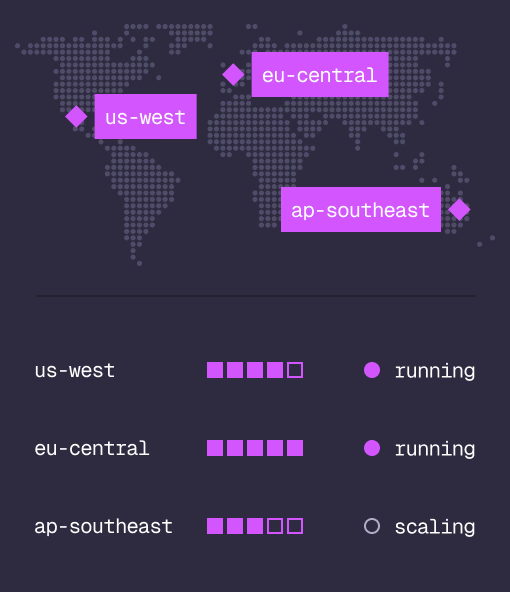
Managed clusters in the regions you choose, scaled on demand.
Studio
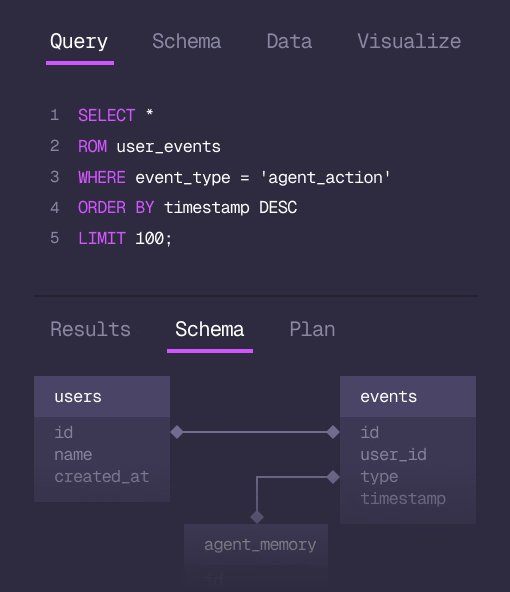
Query, explore and design the schema from the browser.
MCP
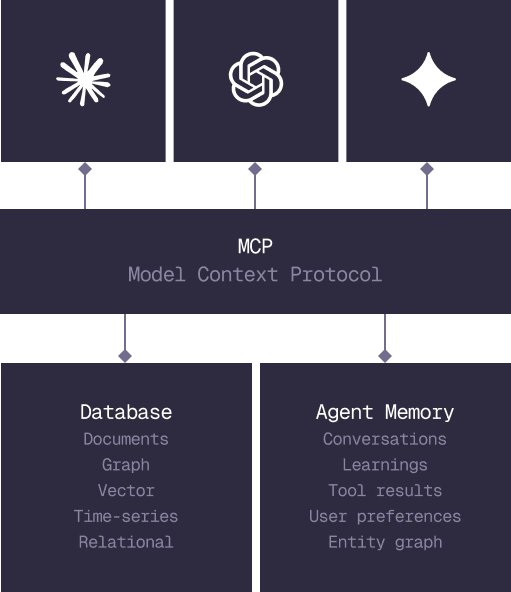
Every model that speaks MCP reaches the database and the memory directly.
IN PRODUCTION
Trusted at scale. Samsung, Nvidia, Verizon, Tencent, and Walmart run on SurrealDB.
14,000+
Developers building on SurrealDB Cloud
4M+
Developers building on SurrealDB worldwide
FROM THE TEAMS
SurrealDB gives us a foundation where we can unify semantic search, knowledge graphs, and AI-driven decision making without stitching together multiple systems. Collapsing responsibility into SurrealDB has become our default engineering posture.
VP of Engineering, Later
GET STARTED
Start building with SurrealDB. Telemetry, digital twins and predictive maintenance in one real-time engine.