


















SurrealDB vs. Postgres
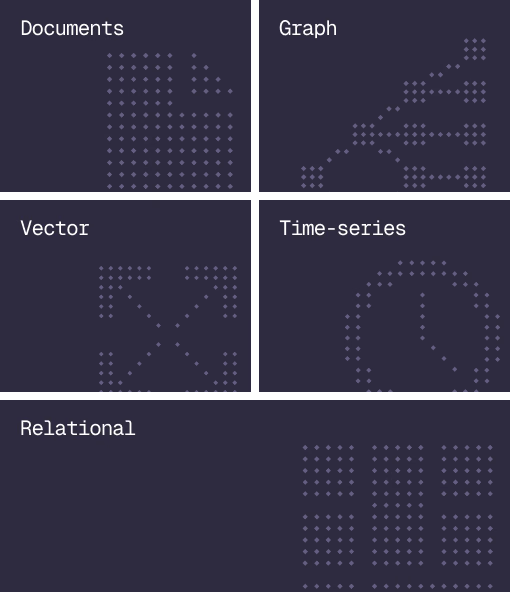
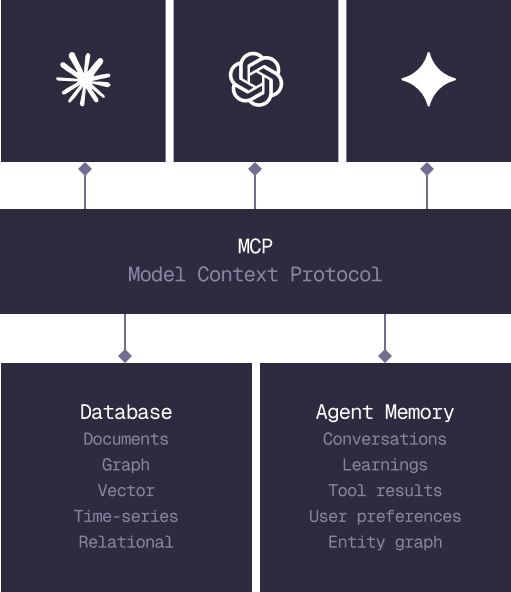
SurrealDB natively unifies relational, graph, vector, document and temporal data in a single engine, no extensions or workarounds
SurrealDB runs all of this natively in one system.
SurrealDB natively unifies relational, graph, vector, document and temporal data in a single engine, no extensions or workarounds
SurrealDB runs all of this natively in one system.
SurrealDB is used where retrieval accuracy, operational efficiency, and scale matter.


at a glance
Postgres is a powerful relational database, but AI and retrieval workloads stretch it beyond its original design. Combining vectors, search, constraints, and relationships adds indexing and operational complexity.
SurrealDB handles these workloads natively - no workarounds required.
Supports vectors, full-text search, and relational queries, but retrieval requires manual joins, CTEs, multi-stage pipelines, and extra tooling.
Vectors, full-text search, document filters, and graph traversal in a single native query — no plugins or frameworks required.
Relationships are expressed indirectly through joins and cannot participate naturally in retrieval semantics.
Native graph traversal brings relationship-aware context directly into retrieval.
Storage and compute costs grow with index count, replicas, and data duplication.
Typically compresses PostgreSQL data by 70-80%, reducing storage, network, and compute costs.
Postgres expresses relationships through foreign keys and joins. As queries grow more complex, joins increase planning time, execution cost, and index dependency.
SurrealDB performs relationship-style querying without joins. Relationships are first-class and traversed directly, eliminating join planning and reducing query complexity.
Relationships expressed through joins
Query cost increases with join depth
Heavy reliance on secondary indexes
Native graph model
Direct traversal without joins
Relationships participate directly in retrieval logic
Postgres scaling relies on primary/replica setups and manual sharding, increasing complexity and risk.
SurrealDB scales horizontally without sharding or manual coordination.
Postgres depends on secondary indexes for performant joins and filters, which grow costly as schemas evolve.
SurrealDB encodes record location in its primary keys, resolving relationships directly and reducing the need for secondary indexes.
Schema changes on large tables are disruptive and difficult to perform safely.
Schema can be introduced incrementally and evolved live without downtime.
Index rebuilds can block writes and impact availability. Index composition is limited.
Indexes are built and maintained concurrently without locking, across vectors, documents, and relationships.
Full-text search relies on specialised functions and patterns that do not compose cleanly with vectors and joins.
Full-text search is native and fully composable with vector similarity and relationship traversal.
Postgres with pgvector can be extended to approximate modern retrieval - but at the cost of joins, indexes, sharding, and operational complexity.
SurrealDB delivers relationship-aware retrieval, lower cost, and simpler scaling in one unified engine.
Business model
PostgreSQL
Fully open source database with a large ecosystem of extensions required to support modern workloads.
SurrealDB
Fully open source and available for use. Commercial offering is built on the same core engine without fragmenting capabilities.
Availability
PostgreSQL
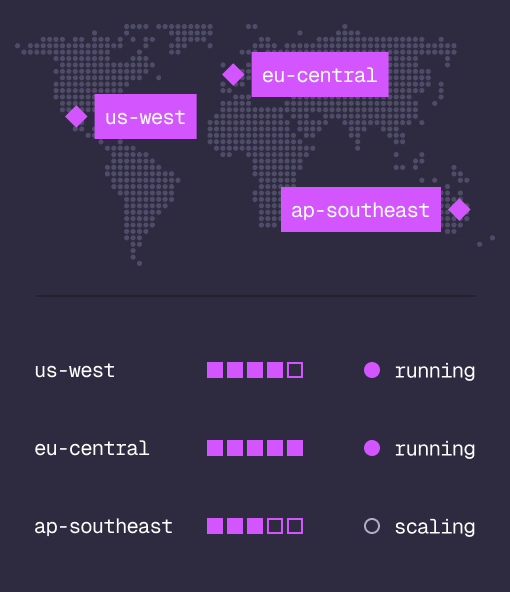
Runs locally, on-premises, and on all major public clouds. Distributed deployments require external tooling and differ significantly from single-node behavior.
SurrealDB
Runs locally, on-premises, and on all major public clouds. Deployable as embedded, single-node, or distributed. Identical capabilities in all environments.
Architecture
PostgreSQL
Monolithic relational engine originally designed for single-node operation. Extensions (pgvector, FTS, JSON) bolt additional capabilities onto a core not designed for multimodel execution.
SurrealDB
Distributed, multi-model database with a decoupled query and storage layer. Designed to be efficient both as a single node and as a distributed system. Excels at heavy read/write workloads.
Scale
PostgreSQL
Scaling beyond a single node requires manual primary/replica coordination. Write scaling is limited. Large deployments commonly require manual sharding, increasing operational and application complexity.
SurrealDB
Horizontally scalable for both reads and writes by adding query nodes and scaling the underlying distributed storage layer. Designed to eliminate the need for sharding. Suitable for very large datasets and high throughput.
Resilience
PostgreSQL
Primary/replica architectures introduce failover complexity. Loss of the primary impacts write availability until recovery.
SurrealDB
High availability and fault tolerance provided by the distributed backend. No single node failure brings down the system.
Transactional consistency
PostgreSQL
Strong ACID guarantees within a single node. Distributed consistency depends on external tooling and architecture choices.
SurrealDB
Supports distributed ACID transactions with strong consistency guarantees across all supported models.
Models
PostgreSQL
Relational database with JSON, full-text search, and vector support via extensions. No native graph model or temporal graph querying.
SurrealDB
Native multi-model database supporting document, relational, graph, key-value, time-series, vector, full-text search, and geospatial access patterns in one system.
Relationship querying
PostgreSQL
Relationships expressed through foreign keys and joins. Query complexity and cost increase with join depth and cardinality.
SurrealDB
First-class relationships traversed directly without joins. Relationship queries do not require join planning or join indexes.
Indexing model
PostgreSQL
Heavy reliance on secondary indexes for joins and filters. Index rebuilds can block writes and increase operational overhead as schemas evolve.
SurrealDB
Fewer secondary indexes required. The primary key of each record encodes its location, enabling direct access and relationship traversal without join indexes. Indexes are built and maintained concurrently without locking.
Schema evolution
PostgreSQL
Schema changes on large tables are disruptive and operationally risky. Migrations often require maintenance windows.
SurrealDB
Schema-flexible by design. Teams can start schemaless and incrementally enforce schema without downtime.
Pricing and cost efficiency
PostgreSQL
Infrastructure and operational costs grow with index count, replicas, and sharding. Storage and compute costs scale with data duplication and coordination overhead.
SurrealDB
Straightforward pricing with architectural efficiency. Typically provides 70-80% compression of PostgreSQL data, significantly reducing storage and infrastructure costs. Costs scale linearly with usage.