
















New

Vector RAG that actually understands context

Register now

1/2

Glow

SurrealDB vs. MongoDB

SurrealDB is a unified, transactional, multi-model database. MongoDB is a document-oriented database with multiple specialised subsystems.

MongoDB started as a document store and later added search, vector, and limited graph features through separate systems. SurrealDB was built from the ground up to run document, relational, graph, vector, full-text, and temporal queries natively in one engine.

True multi-model engine

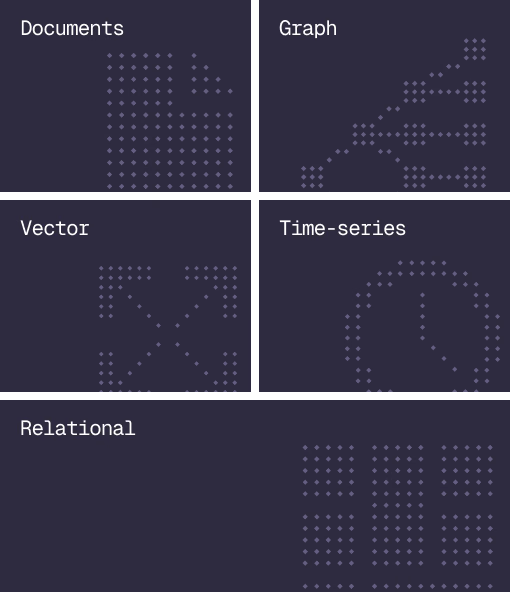
Document, relational, graph, vector, full-text, temporal, and geospatial access patterns natively in one system.

True multi-model engine

Temporal graph querying

Time is treated as a first-class constraint within graph traversal.

Temporal graph querying

Unified indexing

No compound multikey limitations across arrays or nested fields.

Unified indexing

ACID without locking

Transactions across all data models without global or table-level locking.

ACID without locking

Built for modern applications and AI agents

SurrealDB is built for systems that need correctness, composability and consistent semantics across complex queries.

SurrealDB vs. MongoDB

at a glance

As apps demand richer models, temporal logic, and AI retrieval, document-centric systems with external subsystems hit composability limits.

MongoDB splits document, search, and vector execution across separate paths. SurrealDB runs everything in one distributed engine with consistent semantics.

Business-critical capabilities

MongoDB

Document-first database with no relational query planner or cost-based join optimisation. Limited graph traversal and no first-class temporal semantics.

SurrealDB

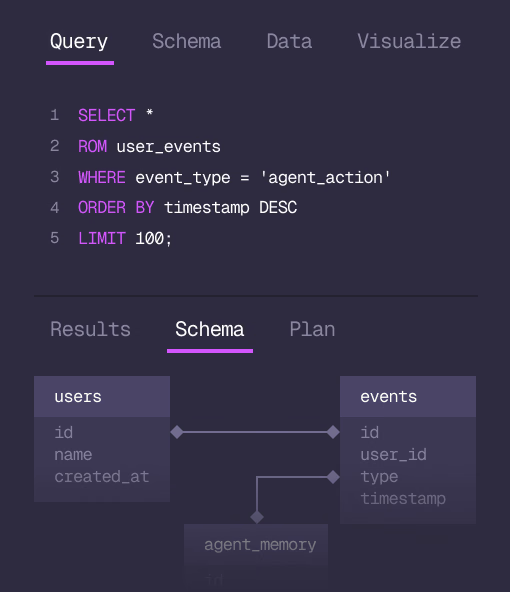
Native document, relational, graph, vector, full-text, and temporal querying in one engine.

Platform openness and composability

MongoDB

Search and vector queries run through Atlas Search (Lucene-based) and must appear first in pipelines, limiting composability.

SurrealDB

All query primitives are first-class and fully composable within a single execution plan.

Cost and performance

MongoDB

Contention increases transaction overhead, and separate core vs. search/vector execution adds complexity.

SurrealDB

Unified execution reduces coordination overhead, hardware usage, and system sprawl.

SurrealDB delivers enterprise-grade correctness and consistency

ACID across all data models

MongoDB supports ACID transactions, but they’re limited, costly under contention, and don’t span search, vectors, or graph traversal.

SurrealDB provides ACID transactions natively across all models in one engine.

No locking, predictable concurrency

MongoDB uses coordination-heavy concurrency control that adds overhead under concurrent workloads.

SurrealDB avoids global and table-level locks for concurrency, enabling predictable reads and writes.

Temporal correctness by design

MongoDB lacks temporal graph traversal - time filters can't participate directly in traversal semantics.

SurrealDB supports native temporal graph querying with time constraints built into traversal logic.

Enterprise takeaway

MongoDB is optimised for document-centric workloads.

SurrealDB is optimised for correctness, composability, and consistency across complex, evolving datasets.

SurrealDB is open and unified by design

One engine, not fragmented subsystems

MongoDB runs full-text and vector search through Atlas Search (Lucene) outside core CRUD, without full transactional consistency.

SurrealDB executes documents, graphs, vectors, and full-text search in one distributed engine.

Indexing without structural limits

MongoDB supports full-text indexing, but Atlas Search runs as a separate Lucene engine with delayed consistency and added overhead. Compound indexes are also limited with nested arrays, limiting efficient indexing of deeply nested or multi-array document models.

SurrealDB provides native full-text search and indexing across arrays, nested fields, vectors, and relationships without these constraints.

Flexible schema without trade-offs

MongoDB is a schema-optional database; its schema validation is enforced only at write time, does not encode relationships or retroactively protect existing data, and reduces performance.

SurrealDB allows you to start schemaless and progressively enforce schemas with DB-level guarantees, with native enforcement, preserving relationships and full transactional consistency.

Platform takeaway

SurrealDB replaces fragmented document-oriented architectures with a single, consistent platform capable of executing application and AI workloads end to end, including native support for custom in-database logic such as triggers, events, and procedural logic.

SurrealDB & MongoDB compared

Commercial offerings build on the same core engine without fragmenting capabilities.

Business model

MongoDB

Source-available, with key capabilities gated behind commercial offerings and Atlas-managed services.

SurrealDB

Open source and available for use. Commercial offerings build on the same core engine without fragmenting capabilities.

Availability

MongoDB

Runs locally, on-premises, and in major clouds, but advanced search, vectors, and scaling mainly depend on Atlas, with limited self-managed support.

SurrealDB

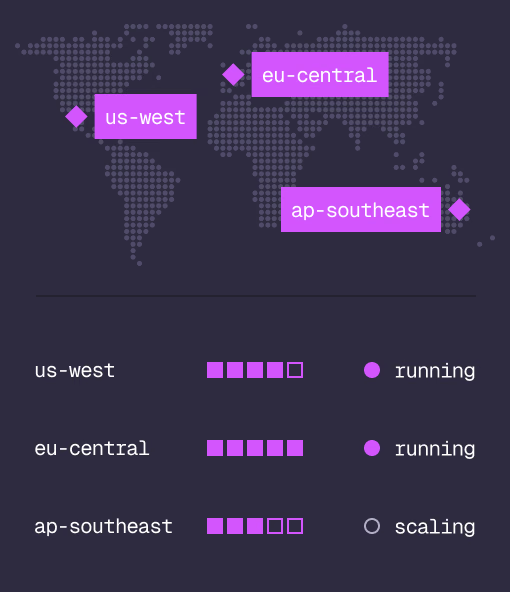
Runs locally, on-premises, and on all major public clouds. Deployable as embedded, single-node, or distributed.

Architecture

MongoDB

Document-first with limited graph traversal and no planner-driven relational semantics. Secondary views, FTS and vectors require duplicated data and separate async pipelines.

SurrealDB

Unified, distributed multimodel engine. Query execution, indexing, storage, and transactions operate inside a single system. Designed for mixed read and write workloads.

Scale

MongoDB

Scales through sharding, which introduces operational complexity. Transaction coordination overhead increases as scale and concurrency grow.

SurrealDB

Horizontally scalable across reads and writes. No sharding required for query semantics. Designed for large, continuously evolving datasets.

Resilience

MongoDB

Separate subsystems introduce additional operational dependencies. Search and vector results are not transactionally consistent with core data.

SurrealDB

Distributed execution without dependency on separate subsystems. Failures do not fragment query correctness or transactional consistency.

Transactional consistency

MongoDB

ACID transactions are limited, costly under contention, and don’t extend to search, vectors, or graph traversal.

SurrealDB

ACID transactions across documents, relational joins, graph traversal, vector search, and full-text search. No global or table-level locks.

Models

MongoDB

Document-first. Graph traversal support is limited and non-composable. Relational semantics are limited and not planner-driven.

SurrealDB

Native support for document, relational, graph, key-value, time-series, vector, full-text search, and geospatial access patterns in one engine.

Temporal capabilities

MongoDB

No temporal graph querying. Time filters cannot participate directly in traversal semantics.

SurrealDB

Temporal querying is first-class. Time constraints participate directly in graph traversal and filtering.

Indexing

MongoDB

Compound indexes may include only one array field. Deeply nested or multi-array document models cannot be efficiently indexed.

SurrealDB

Indexing across arrays, nested fields, vectors, and relationships without compound multikey restrictions.

Query execution

MongoDB

Queries split into multiple stages, with $search required first. There's no unified planner across document, $search, vector, and graph operations, increasing latency from execution boundaries and data handoffs.

SurrealDB

Single declarative query language with a unified execution plan. All retrieval primitives are co-planned and optimized together.

Pricing

MongoDB

Costs increase with sharding, coordination overhead, Atlas dependency, and duplicated subsystems. Operational complexity grows as scale increases.

SurrealDB

Straightforward pricing with architectural efficiency reducing infrastructure and operational cost as scale grows. Lower TCO than MongoDB Atlas at comparable scale.

Reflection subtle

LET'S GOOOO

Ready to build your solution?

The multi-model database for AI agents. Unify data. Unlock intelligence. Scale anywhere.