














SurrealDB vs. agent databases
HelixDB, HydraDB, ReasonDB, and other specialist agent databases correctly identify that flat vector stores are insufficient. But combining graph and vector in one product is not the same as unifying them in one engine.
Agent databases self-host separate vector and graph substrates, but no ACID across models, no native document model, no enterprise governance, and no Gen 3 storage. They internalise the multi-system architecture rather than eliminating it.SurrealDB is the only system that owns the full vertical.
THE LANDSCAPE
Purpose-built for agents, but architecturally incomplete
A growing wave of specialist databases and memory platforms target the agent memory wedge. They correctly identify that flat vector stores are insufficient, but each internalises the multi-system architecture rather than eliminating it.
HelixDB
Rust-based graph-vector database with its own query language and MCP support. Strong developer experience, but no native document model or enterprise governance.
HydraDB
Plug-and-play memory infrastructure with context evolution tracking. Graph and vector are separate internal substrates with no unified ACID transactions.
ReasonDB
AI-native document database using LLM-guided tree traversal instead of flat RAG chunks. Novel retrieval, but no graph model, no temporal versioning, no multi-model unification.
THE PROBLEM
Internalised frankenstack
These products self-host separate vector and graph substrates and fuse results at the application layer. The components have distinct consistency models. Self-hosting internalises the multi-system architecture rather than eliminating it.
committed
inconsistent state
rolled back
Vector DB
Similarity search
Graph DB
Relationship store
Doc store
Raw document index
Auth service
Identity & tokens
Five systems. Five auth configs. Five things to scale, secure, and keep alive.
No ACID across models
When graph and vector live in separate engines, a graph edge can reference a vector embedding that has been updated but not yet committed. Queries see inconsistent state.
No native document model
Every piece of data is a node or an edge. No schema-validated JSON documents with access control, event triggers, or computed fields. Agents need application data too.
No enterprise governance
No row-level permissions, no field-level security, no schema-enforced access control. Production agent systems in regulated industries cannot deploy without these.
No Gen 3 storage
Compute and storage are coupled. Scaling means provisioning more nodes. No scale down to zero, no instant branching, no native disaster recovery.
MCP
Single-product MCP vs. ecosystem MCP
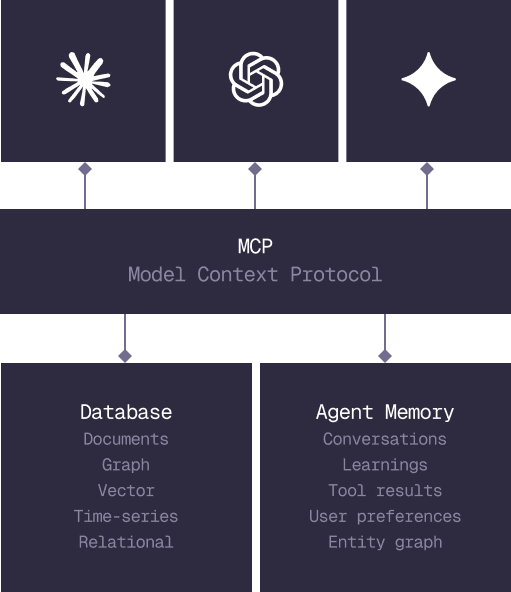
HelixDB highlights MCP support as a differentiator. This is directionally correct - MCP is becoming the standard protocol for agent-to-tool connectivity. But single-product MCP connects an agent to one tool. The SurrealDB ecosystem provides MCP servers across the entire platform: SurrealDB for data queries, Spectron for memory, and SurrealDB Cloud for infrastructure. An agent connected to the Surreal ecosystem can query data, store and retrieve memories, and manage infrastructure - all through standard MCP tool calls.
HelixDB: one MCP server
Connects an agent to a database. One tool, one capability surface. The agent still needs separate connections for memory, infrastructure, and application data.
SurrealDB: ecosystem MCP
Three MCP servers across data, memory, and infrastructure. An agent discovers and invokes capabilities across the entire platform through one protocol.
THE ALTERNATIVE
The only system that owns the full vertical
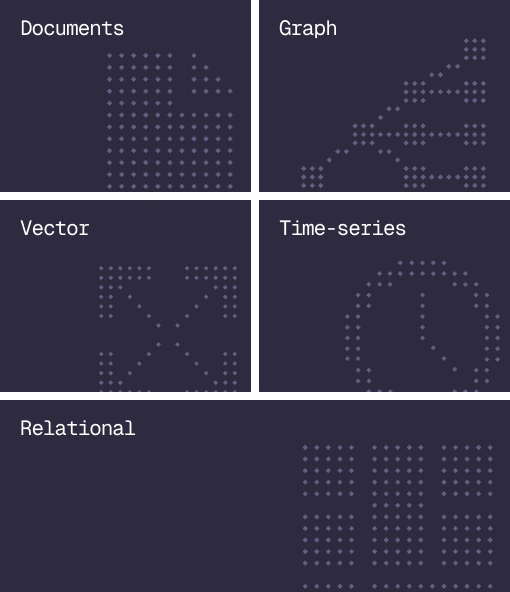
SurrealDB is a mature multi-model database with 7+ years of development, proven at scale by Samsung, Tencent, and enterprises across defence, finance, and healthcare. Spectron builds structured memory directly on this engine. The storage engine provides Gen 3 distributed storage underneath. No other product ships this stack today.
True ACID unification
Graph traversal, vector similarity, document operations, and temporal queries - all in one ACID transaction, resolved from one transactional snapshot.
Full document model
A graph edge is a full document. Relationships carry metadata, timestamps, embeddings, and structured data. Not just key-value properties on a pointer.
Enterprise governance
DEFINE ACCESS with row-level permissions, field-level security, JWT auth, multi-tenant isolation. SOC 2, ISO 27001 compliant.
Gen 3 storage
The storage engine provides compute-storage separation, object-storage backing, scale down to zero, instant branching, and native disaster recovery.
GET STARTED
Build on proven foundations