Agent memory that persists, structures, and connects
Working memory, semantic memory, episodic memory, procedural memory, and preference memory - all structured, all queryable, all in one transactional system.

MEMORY TYPES
Five types of memory for agents
Human cognition uses multiple memory systems. Agents benefit from the same separation. Spectron maps each memory type to structured storage with graph relationships and temporal awareness.
Working memory
Current session context - the conversation history, tool outputs, and intermediate results the agent is actively reasoning over.
Semantic memory
Facts and knowledge - entities, relationships, and properties stored as a knowledge graph. 'Paris is the capital of France.'
Episodic memory
Past interactions and experiences - what happened, when, with whom, and what the outcome was. Agents learn from history.
Procedural memory
Learned patterns and workflows - successful strategies, tool usage patterns, and decision heuristics accumulated over time.
Preference memory
User preferences, feedback, and interaction patterns. Agents personalise without re-learning from scratch.
Shared memory
Memory accessible across multiple agents. Coordination happens through shared context with ACID guarantees.
AUTONOMOUS UNDERSTANDING
Memory that keeps thinking
Most memory systems are passive. They store what agents tell them and retrieve what agents ask for. Spectron's memory is active - background processes autonomously discover connections between entities, consolidate fragmented knowledge, and infer relationships that no single conversation could reveal.
Connection discovery
Relationships between entities mentioned in separate conversations are discovered automatically as context accumulates.
Knowledge consolidation
Fragmented facts from dozens of interactions merge into coherent entity profiles. Understanding becomes structured over time.
Implicit inference
New facts are derived from the graph without being explicitly stated. The knowledge graph grows richer than the sum of its inputs.
MEMORY VS. RAG
Memory is not RAG
RAG retrieves relevant text chunks using vector similarity. Memory understands entities, tracks changes over time, resolves references, and accumulates knowledge. RAG answers “what text is relevant?” Memory answers “what does the agent know?”
RAG: retrieval
Vector similarity search over document chunks. Stateless - every query starts fresh. No entity awareness, no temporal reasoning, no knowledge accumulation.
Memory: understanding
Structured knowledge graph with entity disambiguation, temporal facts, preference accumulation, and episodic recall. Stateful - the agent builds knowledge over time.
THE PROBLEM
The fragmented memory tax
Memory middleware like Mem0 layers a memory API on top of external databases - a vector store here, a key-value store there, maybe a graph database for relationships. Every layer adds latency, failure modes, and consistency gaps.
Consistency gaps
Memory in one store, state in another. No unified transactions means no guarantees that memory and data stay in sync.
Latency compounds
Each system adds a network hop. Memory retrieval that should take milliseconds takes tens of milliseconds across systems.
Operational burden
Three to five systems to deploy, monitor, back up, and secure. Each one is a potential failure point.
No unified permissions
Different permission models for memory, vectors, and structured data. Security policies cannot be applied consistently.
THE SOLUTION
Atomic context with Spectron
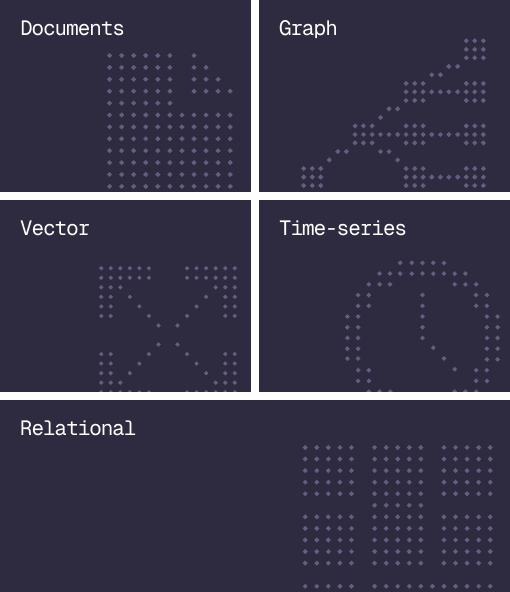
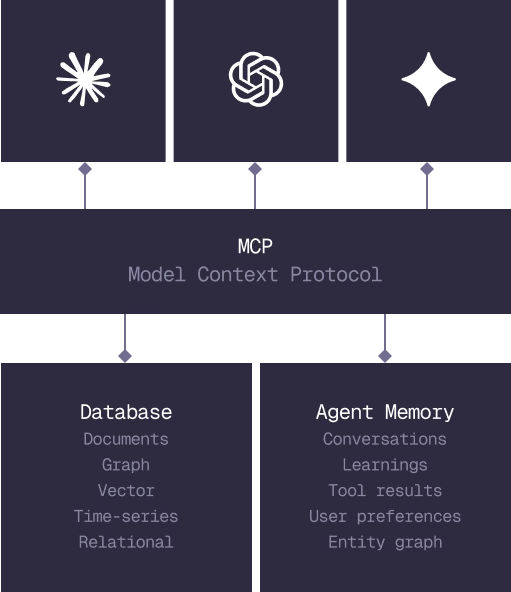
Spectron runs on SurrealDB. Memory, knowledge graphs, vectors, and structured data share the same ACID transaction boundary. No middleware, no glue code, no consistency gaps.
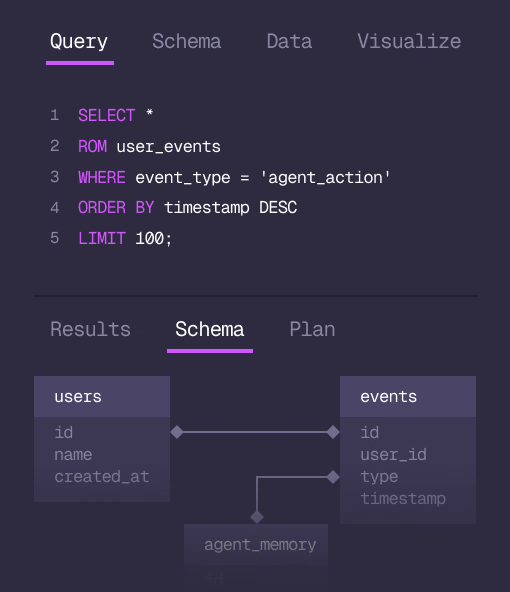
Spectron stores memory as structured records in SurrealDB with graph relationships between entities. Facts, preferences, episodes, and procedures are all queryable with SurrealQL and benefit from ACID transactions, bi-temporal versioning, and RBAC permissions.
Yes. Because Spectron runs on SurrealDB, memory and application data live in the same system. A single SurrealQL query can join agent memory with structured application data, graph relationships, and vector embeddings.
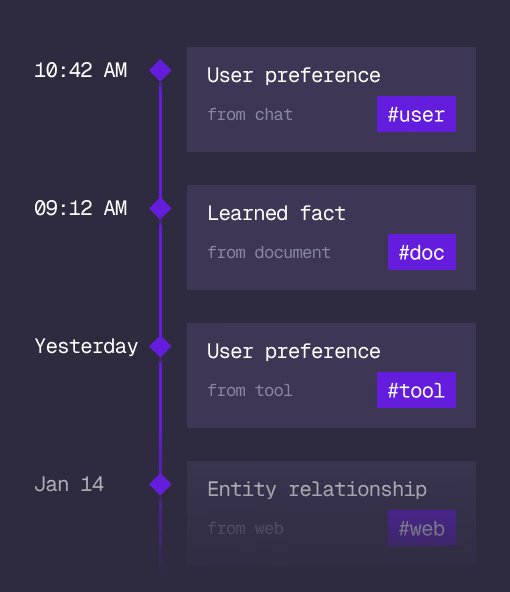
Spectron uses bi-temporal versioning - every fact tracks when it was true and when it was recorded. Conflicting information is stored as temporal facts with validity periods, allowing agents to reason over the most current information while retaining history.
GET STARTED
Give your agents memory
Structured memory for AI agents - working, semantic, episodic, procedural, and preference memory types.