12: People and indexes
The project planning sample assigns work to employees, and it leans on indexes to keep lookups fast and data honest. This chapter adds people to the schema, then looks at REFERENCE and DEFINE INDEX, including UNIQUE constraints.
SurrealKit-wise, nothing new lands here. You already know sync for a disposable local database and rollout plan → start → complete for a shared one (parts 10–11). Put the definitions below into database/schema/, then apply them the same way you applied milestone. The new material is the SurrealQL: employees, REFERENCE, and indexes.
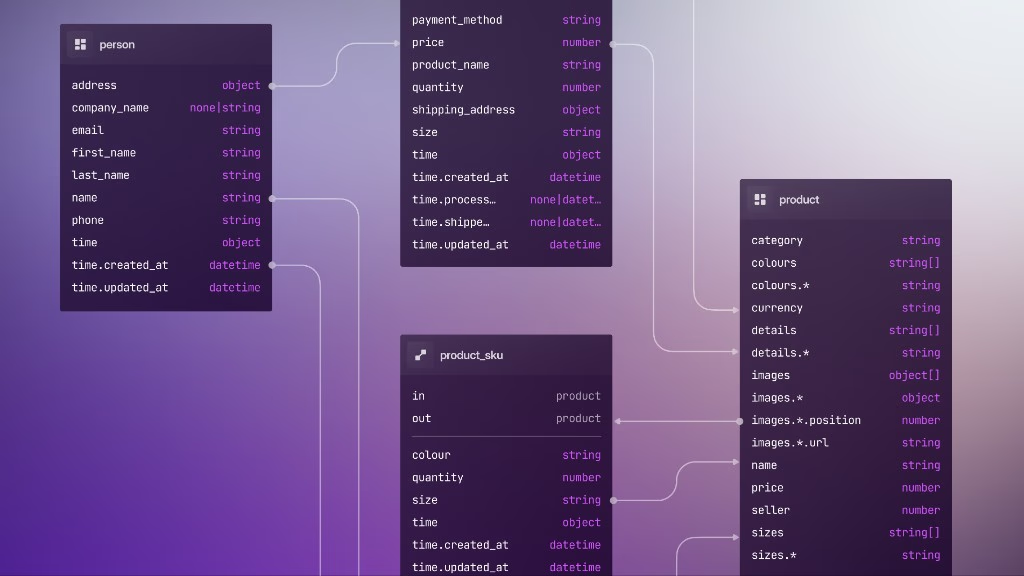
Employee table
Add a table for the people doing the work. Create database/schema/employee.surql:
DEFINE TABLE employee SCHEMAFULL;
DEFINE FIELD name ON employee TYPE string;
DEFINE FIELD email ON employee TYPE option<string> ASSERT $value IS NONE OR string::is_email($value);
Assigning activities to people
An activity will not always have someone assigned yet, so the field on activity needs to allow for that. Add this to database/schema/activity.surql:
DEFINE FIELD assigned_to ON activity TYPE option<record<employee>>;option means that "nobody assigned yet" is a valid state, not a missing field. If a later requirement says every activity must have an owner, you would tighten this the same way you tightened fields earlier in the course: backfill the data, then ALTER (part 3).
Create an employee and assign them to an existing activity so you have something to query:
CREATE employee:ada SET name = "Ada", email = "ada@example.com";
UPDATE activity:kickoff SET assigned_to = employee:ada;
REFERENCE and what happens on delete
As things stand, nothing stops you deleting employee:ada even though an activity points at her. If you would rather SurrealDB refused that delete, add a REFERENCE clause. Replace the assigned_to line you just wrote rather than adding a second one, for the reason given in part 8: with two definitions for one table and field name, the second silently replaces the first.
DEFINE FIELD assigned_to ON activity TYPE option<record<employee>>
    REFERENCE ON DELETE REJECT;
With employee:ada still assigned to activity:kickoff, the delete is now refused:
DELETE employee:ada;'Cannot delete `employee:ada` as it is referenced by `activity:kickoff` with an ON DELETE REJECT clause'| Clause | Effect |
|---|---|
REFERENCE ON DELETE REJECT | Cannot delete employee while an activity points at them |
ON DELETE CASCADE | Deleting the parent removes or clears children (use carefully) |
ON DELETE IGNORE | Parent delete allowed; links may dangle unless you clean up |
REFERENCE is catalog metadata that SurrealDB enforces on delete. That is different from a bare record<> field (part 4), which just stores a pointer and does nothing special when the record it points to disappears.
Indexes for the queries you actually run
Lookup by project name
DEFINE INDEX project_name ON project FIELDS name;This supports WHERE name = … on a long list of projects. It does not need to be UNIQUE unless project names must be distinct.
Unique milestone per project
DEFINE INDEX milestone_name_per_project ON milestone FIELDS project, name UNIQUE;UNIQUE indexes stop duplicates at write time, which is exactly what you want for (project, name). Before adding one on a table that already has data, check for duplicates first (part 3).
We can do this by filtering the grouped result with an outer SELECT:
SELECT * FROM (
    SELECT project, name, count() AS total FROM milestone GROUP BY project, name
) WHERE total > 1;
On a small table you can also just read the counts and skip the outer filter:
SELECT project, name, count() AS total FROM milestone GROUP BY project, name;If either returns records, backfill or rename the duplicates in a data script before you add the index, whether that is a local sync or a rollout start on a shared database.
Activity date ranges
Scheduling queries usually filter on start or end:
DEFINE INDEX activity_start ON activity FIELDS start;Composite indexes are worth adding once your actual query patterns justify them. See DEFINE INDEX for the full syntax.
ASSERT or a UNIQUE index?
| Mechanism | Enforces | Also helps |
|---|---|---|
ASSERT on a field | Rules for a single record | n/a |
UNIQUE index | No duplicate combinations across records | Fast lookups |
Uniqueness of (project, name) is a cross-row rule, so it belongs on an index, not a handwritten ASSERT over a subquery.
Indexes and SurrealKit
Adding an index is non-destructive, so it is safe on rollout start (or a local sync). Dropping one is destructive, so save that for rollout complete, once nothing depends on it any more.
Remember that SurrealKit applies whole files. Whenever a later change touches activity.surql, the file is applied again with DEFINE INDEX … OVERWRITE, and SurrealDB rebuilds activity_start from scratch even though the index itself did not change. That costs nothing on a course database, but on a large table it is a reason to keep indexes in a file of their own.
surrealkit sync --user root --pass secret --ns main --db main   # local
# or
surrealkit rollout plan --name add_planning_indexes
Checkpoint
REFERENCEON DELETE REJECT(or whichever delete policy fits)DEFINE INDEXfor lookups,UNIQUEwhere duplicates would be a bug
THE PLATFORM
Everything an application and its agents know. Five surfaces, one engine.
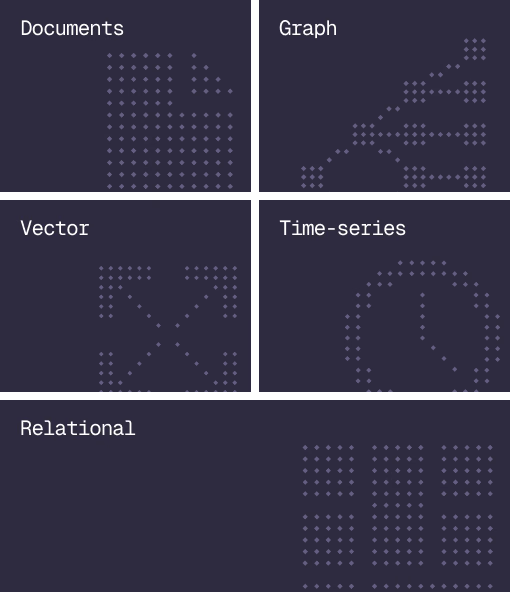
Database
Document, graph, vector, time-series and relational in one engine.
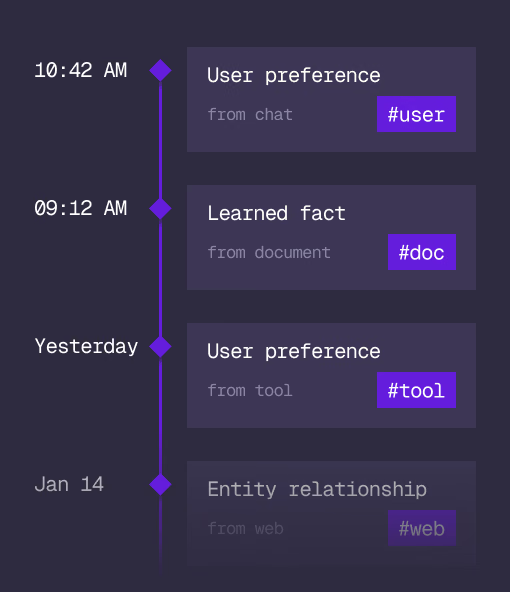
Agent Memory
What an agent learns, with its source and its time, in the same engine.
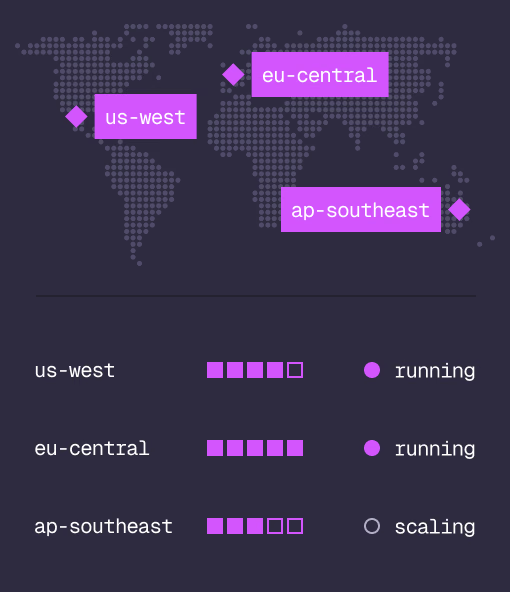
Cloud
Managed clusters in the regions you choose, scaled on demand.
Studio
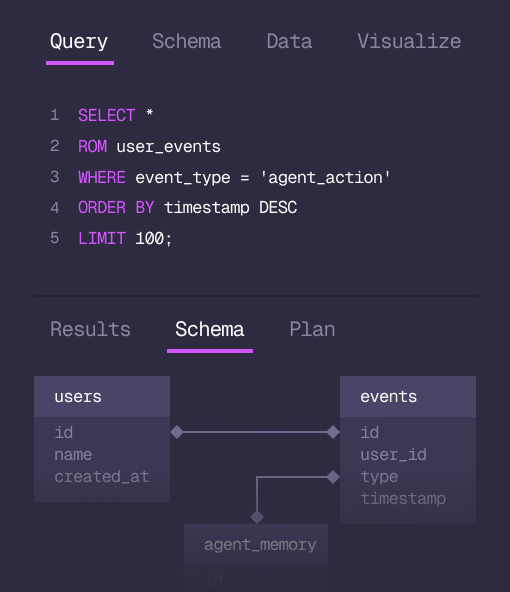
Query, explore and design the schema from the browser.
MCP
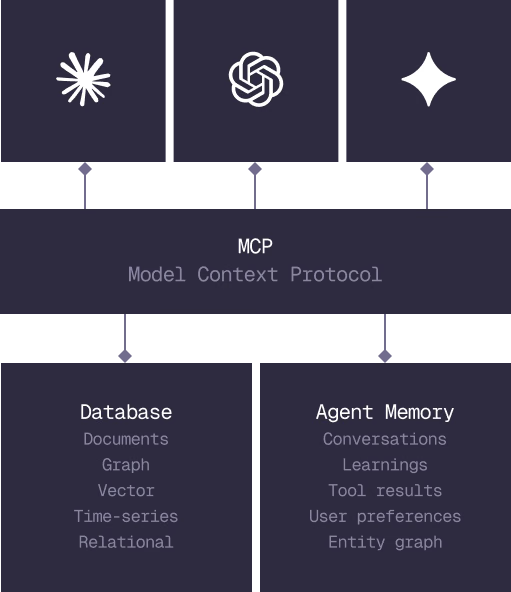
Every model that speaks MCP reaches the database and the memory directly.
IN PRODUCTION
Trusted at scale. Samsung, Nvidia, Verizon, Tencent, and Walmart run on SurrealDB.
14,000+
Developers building on SurrealDB Cloud
4M+
Developers building on SurrealDB worldwide
FROM THE TEAMS
SurrealDB gives us a foundation where we can unify semantic search, knowledge graphs, and AI-driven decision making without stitching together multiple systems. Collapsing responsibility into SurrealDB has become our default engineering posture.
VP of Engineering, Later