13: Viewing the database as a whole
Now that we have some data in the database, let's see what it looks like as a whole. The INFO FOR DB command will do this.
The output shows three schemaless tables. These are automatically created every time you use a CREATE statement for a table that doesn't exist yet. If you want to disable this behaviour, you can start SurrealDB in strict mode. In strict mode, you need to manually define anything before you can use it.
All of the statements inside the INFO FOR DB output are followed by a PERMISSIONS NONE clause, meaning that they can't be accessed by record users - users that aren't core database users.
But inside the Sandbox we are logged in as a root user, so PERMISSIONS NONE doesn't affect us.
{
  accesses: {},
  analyzers: {},
  configs: {},
  functions: {},
  models: {},
  params: {},
  tables: {
    place: 'DEFINE TABLE place TYPE ANY SCHEMALESS PERMISSIONS NONE',
    some_record: 'DEFINE TABLE some_record TYPE ANY SCHEMALESS PERMISSIONS NONE',
    town: 'DEFINE TABLE town TYPE ANY SCHEMALESS PERMISSIONS NONE'
  },
  users: {}
}
One of the tables is called some_record, which we created back on page 6 for a simple demonstration. While we deleted all of its records, the DEFINE TABLE statement to create it in the first place wasn't touched, leaving our database with a DEFINE TABLE some_record that we never used again.
Since we won't be needing it, let's remove it with a REMOVE statement. Since the statement to create it was DEFINE TABLE some_record..., it can be removed with REMOVE TABLE some_record.
NONEThe output is NONE, showing that the statement succeeded and returned nothing. If you try to run the same REMOVE statement again, you'll see an error instead.
"The table 'some_record' does not exist"The statements REMOVE DATABASE or REMOVE NAMESPACE or REMOVE INDEX often require removing quite a bit of underlying data. When you execute one of these statements it will return immediately, after which physical deletion of the actual data takes place in the background.
THE PLATFORM
Everything an application and its agents know. Five surfaces, one engine.
Database
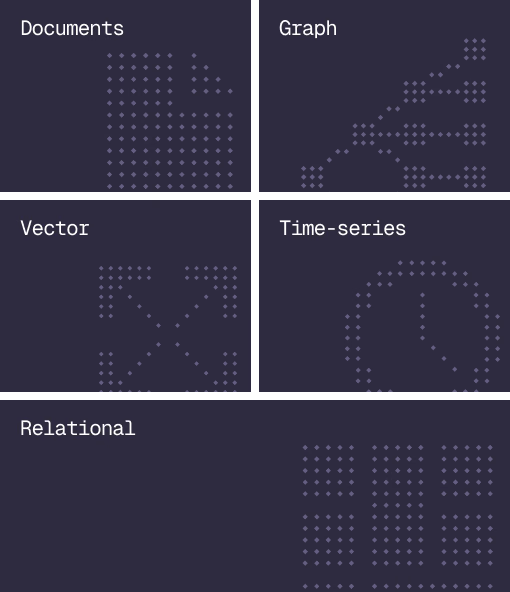
Document, graph, vector, time-series and relational in one engine.
Agent Memory
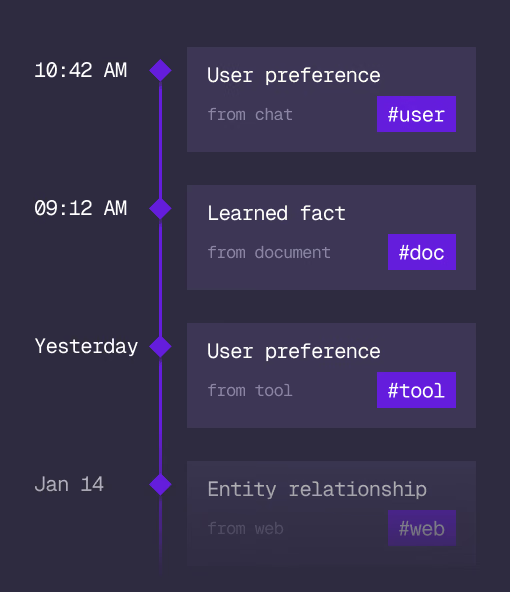
What an agent learns, with its source and its time, in the same engine.
Cloud
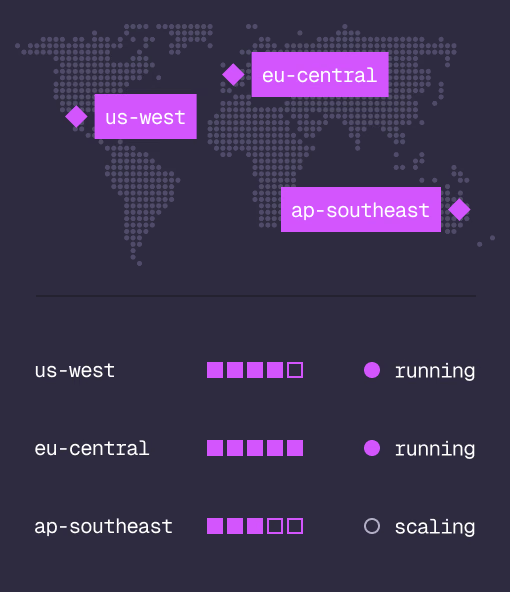
Managed clusters in the regions you choose, scaled on demand.
Studio
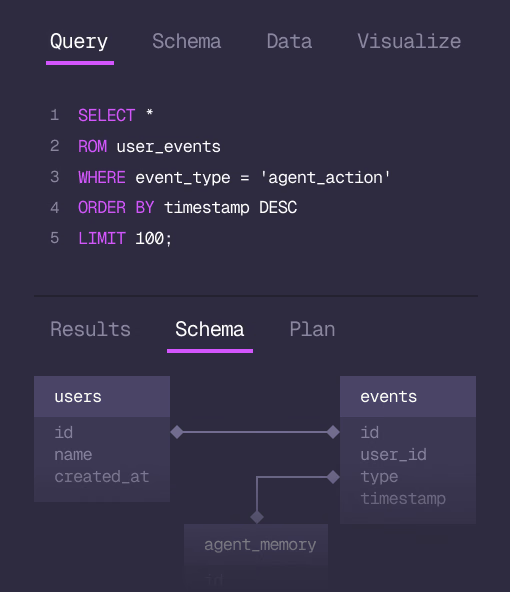
Query, explore and design the schema from the browser.
MCP
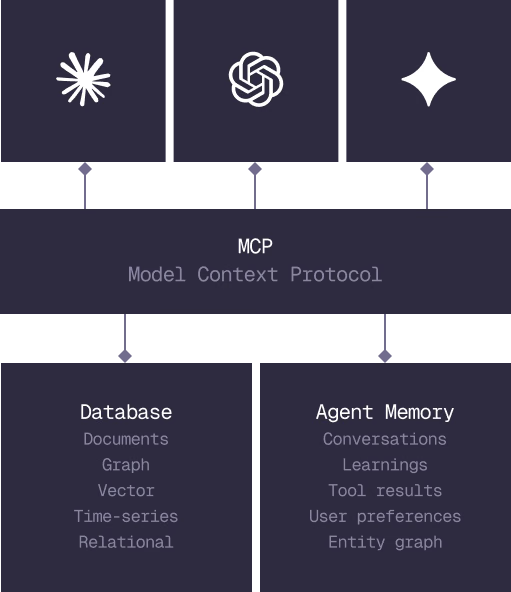
Every model that speaks MCP reaches the database and the memory directly.
IN PRODUCTION
Trusted at scale. Samsung, Nvidia, Verizon, Tencent, and Walmart run on SurrealDB.
14,000+
Developers building on SurrealDB Cloud
4M+
Developers building on SurrealDB worldwide
FROM THE TEAMS
SurrealDB gives us a foundation where we can unify semantic search, knowledge graphs, and AI-driven decision making without stitching together multiple systems. Collapsing responsibility into SurrealDB has become our default engineering posture.
VP of Engineering, Later