An AI agent is only as good as the context it can see - and most of that context is moving. Documents get edited, tickets get closed, new records land every minute. The usual answer is a batch job that re-embeds everything on a schedule and produces an index that's stale the moment it finishes.
It gets worse the moment you want more than vector search. As soon as you care about the relationships between the things you've embedded - who wrote what, which entity belongs to which deal, how one fact connects to another - you end up running a vector database next to a graph database next to a document store, and writing brittle glue to keep all three in sync.
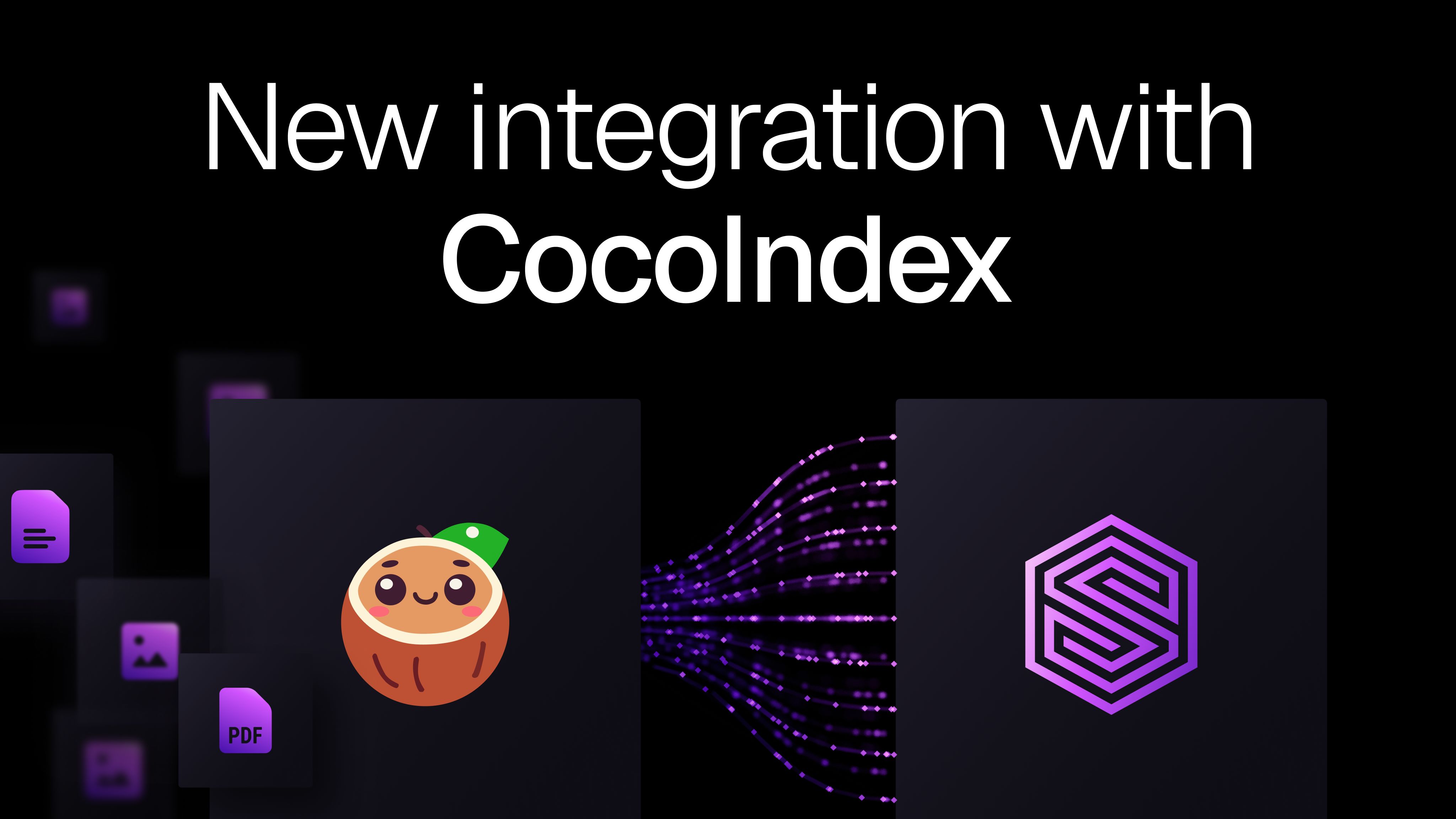
Today that gets a lot simpler. CocoIndex now ships a native SurrealDB connector, so a single declarative pipeline can drive a document store, a knowledge graph, and a vector index - all inside one SurrealDB instance, all kept incrementally fresh.
Why this pairing
CocoIndex is an incremental engine for the data behind AI applications. Instead of writing imperative ETL, you declare the target state you want and the engine reconciles it. The model is closer to a spreadsheet or a React component than a cron job: you describe what should exist, and when a source changes, CocoIndex works out the delta. It identifies the affected records, propagates the change across lookups and joins, updates the target, and retires stale rows - without touching anything that didn't change. Python defines the logic; a Rust core handles high-concurrency execution and state. No full re-embeds, no drift.
SurrealDB is the multi-model database for AI agents: documents, graph, relational, and vectors in one engine, queried with one language. That's the natural home for CocoIndex output - because the SurrealDB connector doesn't just write a vector column. It supports:
Normal tables - your documents, chunks, and structured records.
Relation (graph edge) tables - the relationships between them, written as real SurrealDB graph edges you can traverse with->.
Vector indexes - HNSW or DISKANN indexes.
So the knowledge graph and the embeddings live in the same store, populated by the same flow, kept consistent by the same incremental engine. Hybrid retrieval - vector similarity and graph traversal in a single SurrealQL query - stops being an integration project and becomes a query.
What a pipeline looks like
A CocoIndex flow that embeds products, and writes the result into a SurrealDB table with a vector index is only a few lines:
import cocoindex as coco
from cocoindex.connectors import surrealdb

SURREAL_DB: coco.ContextKey[surrealdb.ConnectionFactory] = coco.ContextKey("main_db")

@dataclass
class Product:
    id: str
    name: str
    price: float
    embedding: Annotated[NDArray, embedder]

@coco.lifespan
def coco_lifespan(builder: coco.EnvironmentBuilder) -> Iterator[None]:
    builder.provide(
        SURREAL_DB,
        surrealdb.ConnectionFactory(
            url="ws://localhost:8000/rpc",
            namespace="test",
            database="test",
            credentials={"username": "root", "password": "root"},
        ),
    )
    yield

@coco.fn
async def app_main() -> None:
    # Declare table target state
    table = await surrealdb.mount_table_target(
        SURREAL_DB,
        "products",
        await surrealdb.TableSchema.from_class(Product),
    )

    # Declare records
    for product in products:
        table.declare_record(row=product)

    # Declare a vector index
    table.declare_vector_index(
        field="embedding",
        metric="cosine",
        method="hnsw",
        dimension=384,
    )
Run it once to backfill. Run it again any time - only the files that actually changed get re-embedded. Point it at a live source and the index stays current on its own.
Because the connector also understands relation tables, the same pattern extends to graphs: extract entities from each document, mount a target per entity type, and RELATE them as you go. Add an entity type and a new table appears; remove one and it's cleaned up - no manual migration, no orphaned data. You get a knowledge graph that maintains itself.
What you can build
This is the missing piece for a few things that were previously painful:
Hybrid RAG without the stitching: Combine vector recall with graph traversal in one query, against one store, instead of federating results across Qdrant, Neo4j, and a document database.
Durable agent memory: Give agents a context layer that's always fresh and richly connected, rather than a snapshot that decays between batch runs.
Get started
The SurrealDB connector is part of CocoIndex v1. Install it and you're a few lines from your first pipeline:
pip install cocoindex[surrealdb]Connector in SurrealDB Docs: surrealdb.com/docs/build/integrations/ai-frameworks/cocoindex
Connector in CocoIndex Docs: cocoindex.io/docs/connectors/surrealdb
We're excited to see what you build on top of it. Tag us in our socials - we'll boost it - or share in
Discord. If you're building agentic or RAG pipelines like this, the #python and #all-ai channels are the best places to get started.