Schemafull CRUD
Now that we've learned how to define both tables and fields, It's time for some schemafull CRUD.
In this lesson, we'll only cover what is different from schemaless CRUD, namely how to update the schema and data for tables and fields using:
The
FIELDclause on theREMOVEstatementThe
OVERWRITEclause on theDEFINEstatementThe
ALTERstatement
Adding and removing fields
When updating our schemaless tables, we could just SET or UNSET fields and they would appear. Not so for a SCHEMAFULL table, however.
In both of these cases we get a schema error. In the first case it's because the new_field field hasn't been defined yet, and in the second because category is a field that can't hold the value NONE, which is what UNSET is trying to do.
For our second UPDATE query which tries to UNSET the category field on our product table, we also get a schema error.
In order to remove a field from our schemafull table, we first need to use the REMOVE FIELD statement.
However, that is not enough to actually remove the field data, as the REMOVE FIELD statement only removes the schema definition.
Once the schema definition is removed, we can use UNSET like we did earlier.
There is however another way, if removing multiple fields, we can simply run UPDATE product and the UPDATE statement will remove anything that is no longer a part of the schema definition.
Updating fields and tables
For updating existing schema definitions there are two options:
The
OVERWRITEclause on theDEFINEstatementThe
ALTERstatement.
For example, we can change the datatype of a field or change a table from schemafull to schemaless.
The difference between these two options is that
DEFINE ... OVERWRITEcan be used to both create new definitions and update existing ones, but needs to include the entire definition.The
ALTERstatement only updates existing definitions and only needs to include the items to be updated, not the entire definition.
Summary
Let's summarise what we've learned.
When adding and removing fields:
You need to use
DEFINE FIELDto add the field to the schema before usingUPDATEto add the data.You need to use
REMOVE FIELDto remove the field from the schema before usingUPDATEto remove the data.
When updating fields and tables:
DEFINE ... OVERWRITEcan be used to both create new definitions and update existing ones, but needs to include the entire definition.The
ALTERstatement only updates existing definitions and only needs to include the items to be updated, not the entire definition.
That's it for this part on making our data schemafull, in the next part, we'll explore how to make our data secure.
THE PLATFORM
Everything an application and its agents know. Five surfaces, one engine.
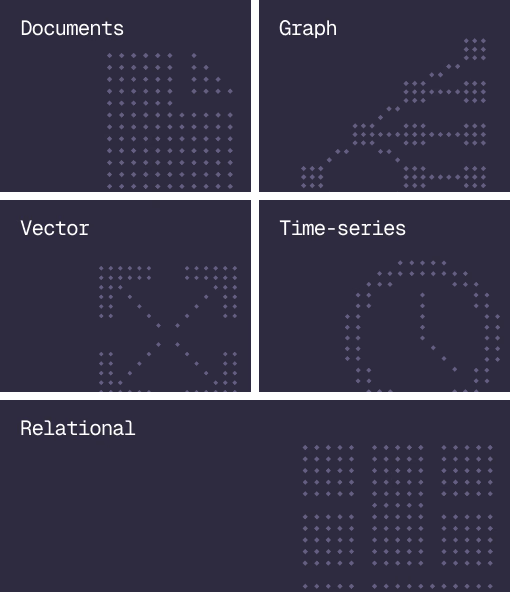
Database
Document, graph, vector, time-series and relational in one engine.
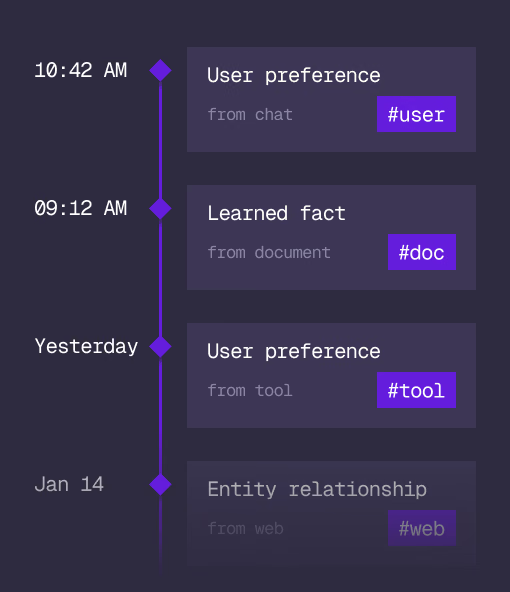
Agent Memory
What an agent learns, with its source and its time, in the same engine.
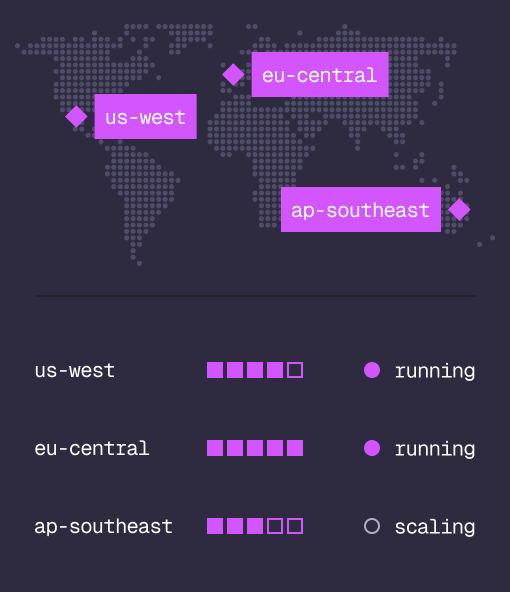
Cloud
Managed clusters in the regions you choose, scaled on demand.
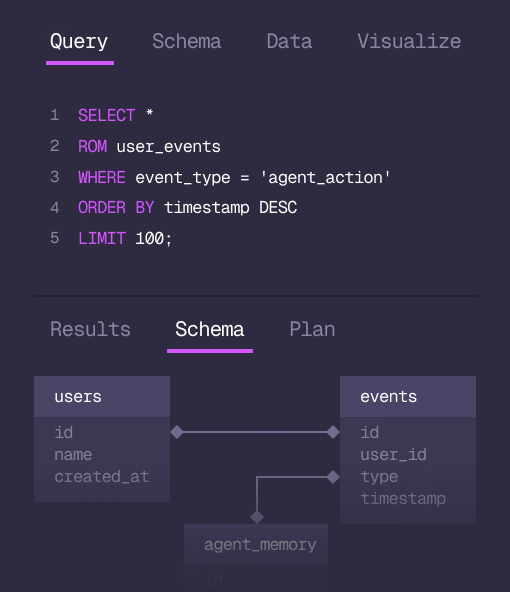
Studio
Query, explore and design the schema from the browser.
MCP
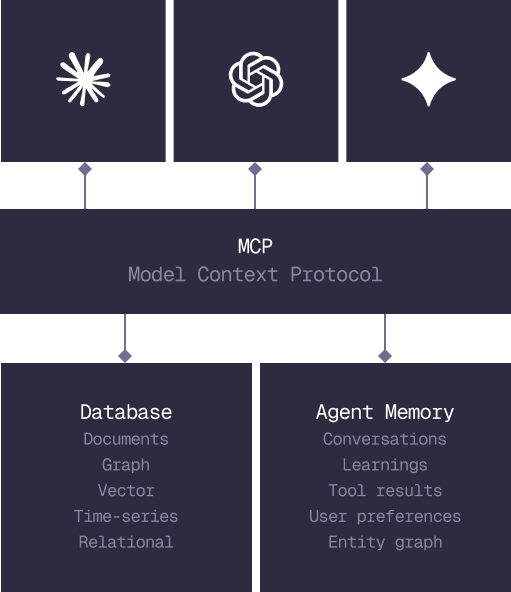
Every model that speaks MCP reaches the database and the memory directly.
IN PRODUCTION
Trusted at scale. Samsung, Nvidia, Verizon, Tencent, and Walmart run on SurrealDB.
14,000+
Developers building on SurrealDB Cloud
4M+
Developers building on SurrealDB worldwide
FROM THE TEAMS
SurrealDB gives us a foundation where we can unify semantic search, knowledge graphs, and AI-driven decision making without stitching together multiple systems. Collapsing responsibility into SurrealDB has become our default engineering posture.
VP of Engineering, Later