


















Pivot AI made the assertion the unit of analysis and cut retrieval cost 20 to 40 times
Pivot AI builds vertical legal intelligence for contested domains, beginning with financial disclosure in law. Its assertion graph records what each party and each document says about the same asset, and the disagreement between them, in SurrealDB.
Challenge
In a financial remedy matter, each party discloses assets and income and the other side tests the disclosure against the documents. The common approach loads a bundle summary into a model's context, and a summary adds a hallucination surface: it can invent or drop material, and the answer inherits the errors with its citations broken.
Omissions fail worst. A summary describes what the documents contain, so a gap in disclosure, the thing the work is looking for, is missed or invented. Pivot concluded the document was the wrong unit of analysis and made the assertion the unit instead.
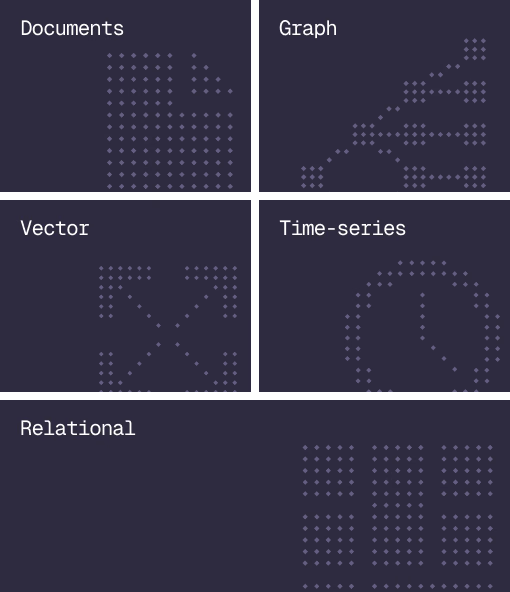
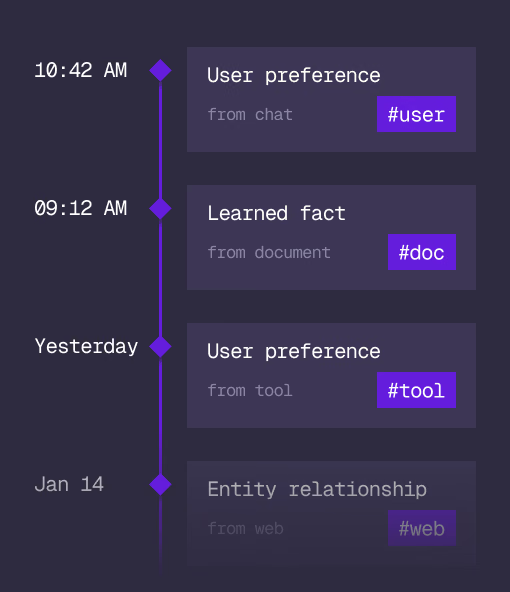
An assertion carries provenance. A declared salary of £68,000 and payslips totalling £91,000 both persist, each with the voice that made it, the document, the page and bitemporal timestamps. Holding that in a graph store, a vector store and a relational store kept in step by application code meant they could disagree at every boundary.
Solution
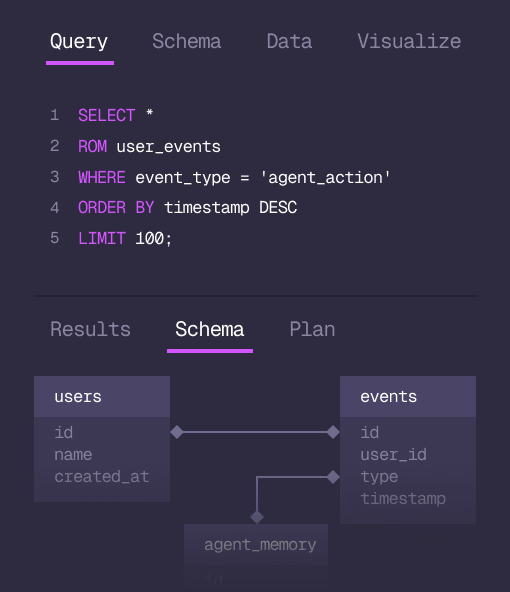
Pivot built the assertion graph on SurrealDB, where an edge is a full record. Voice, source document, page, figure and bitemporal fields sit on the edge, and one SurrealQL statement traverses the graph and reads the record.
Disclosure records are merged after disclosure exchange as same_as edges rather than rewrites, so the pre-merge record stays auditable. Table and field permissions are evaluated per record with access denied by default, which gives each matter isolation inside the engine.
Vector search runs inside the same boundary, scoped to one matter's corpus, in the engine that holds the graph. There is no middleware holding an ontology together across stores, because there is one store.
Results
Retrieval 20 to 40 times cheaper
Against loading a full disclosure bundle into context, a query retrieves the relevant subgraph at 20 to 40 times lower token cost.
Retrieval in 0.27 seconds
Against 3.4 seconds for bundle loading.
Four checkable entity states
Every entity is corroborated, uncorroborated, contradicted or unasserted, each opening to the records behind it, and the fee earner works a queue.
One store
States are computed at query time, and the graph and the vectors share one engine.
What is next
Financial remedy is one instance of a shape that recurs across contested law. Pivot is extending the approach across adversarial matters that share it, and looking to SurrealDB Agent Memory as the matter's memory layer, whose versioned history makes a record's time field checkable.
An assertion edge carries the voice that made it, the document and page it came from, the figure it states and the dates it holds for. SurrealDB stores that as one record and queries it in one statement. We did not write middleware to hold the ontology together, because there is nothing to hold together.