

















Later built a context-aware knowledge graph on SurrealDB and cut campaign planning from days to hours
Later is a social media and influencer marketing platform that helps brands discover creators, launch campaigns and measure performance at scale. Its EdgeAI initiative brings inference, persistence and agentic feedback loops together, and at its core is a knowledge graph on SurrealDB.
Challenge
Influencer marketing is a dynamic problem. Every campaign introduces a different set of variables, from brand safety and audience fit to content style, platform dynamics and emerging trends, and matching the right creators to a campaign means representing how all of those relate.
Before SurrealDB, creator discovery at Later relied on manual work and rigid filters: follower counts, categories and platform-specific metrics. Defining the right creator set for a campaign took hours and still missed the nuance and intent behind a brand's goals.
As Later's AI ambitions grew, so did the strain. Creator data is deeply interconnected and semi-structured, social listening signals and performance history sit awkwardly in tables, and unifying graph relationships, semantic search and predictive modelling meant fragmented infrastructure at the moment the company needed speed, accuracy and scale.
Solution
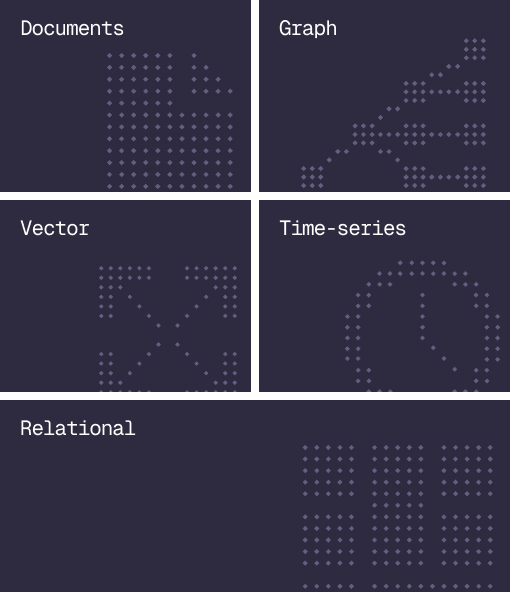
Later chose SurrealDB because one multi-model database combines graph relationships, document flexibility, vector search and transactions, which is what a knowledge graph needs and what is usually assembled from several specialised tools.
On it, Later built a knowledge graph connecting creators, brands, campaigns, content topics, social trends and performance signals. The relationships carry context and metadata that differ between campaigns and update as new content is created, a truer picture of how influencer marketing moves.
This project enables a major shift in how creators are discovered and activated. Rather than relying on filtering by common metrics, Later now offers a performant AI-powered search across creator and brand information, which dynamically employs semantic similarity, conventional filters and graph traversal. Taken together, this mimics the kind of search a domain expert would perform.Kyle Chamberlain, EdgeAI Architect, Later
Running vector similarity search and graph traversal in one query is the differentiator. Later combines semantic relevance with multi-hop relationships, brand safety constraints and historical performance without fragile pipelines between systems.
The new DISKANN index type in v3.1.0 has been critical to the success of this project. The strategy we use to represent creator content results in a very high volume of embeddings to store. This type of index makes it uniquely possible to keep embedding dimensions high and still find closest neighbours quickly as graph investigation entry points.Kyle Chamberlain, EdgeAI Architect, Later
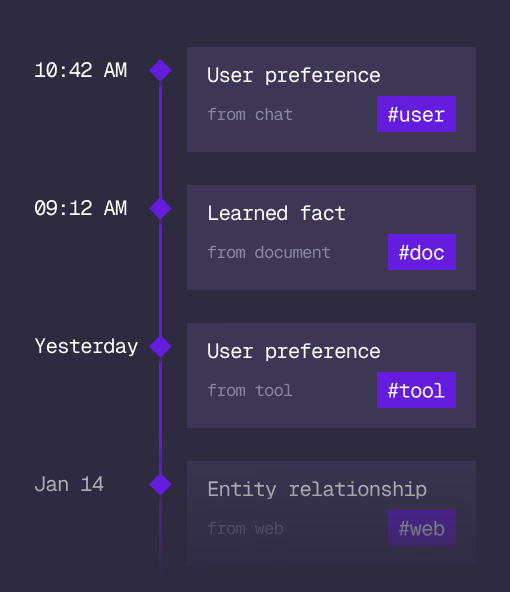
SurrealDB is now a core part of Later's EdgeAI persistence layer. An event-driven ingestion pipeline on Encore parses documents into nodes and relationships and writes each step back into SurrealDB, so campaign insights improve through recursive feedback and learning.
Results
Campaign planning from days to hours
Planning and executing an influencer campaign, which once took days, is done in hours on the context graph.
Creator discovery from hours to minutes
Workflows that needed hours of manual filtering complete in minutes with semantic search and AI-assisted discovery.
More activations per quarter
Later's services teams run more campaigns at the same headcount, and customers launch more creator activations per quarter.
Higher win rates and margins
More campaigns bring more market data, which sharpens matching, which wins larger deals. Later is seeing higher win rates, improved margins and revenue driven by campaign intelligence.
What is next
Parts of the platform still run on Postgres and MySQL. The roadmap consolidates the creator ecosystem, campaign intelligence, social trend data and documents into SurrealDB as a knowledge centre for influencer marketing and the agents built on it.
SurrealDB gives us a foundation where we can unify semantic search, knowledge graphs, and AI-driven decision making without stitching together multiple systems. Collapsing responsibility into SurrealDB has become our default engineering posture.