


















Aspire Comps folded five backend services into SurrealDB and grew to 700,000 users
Aspire Comps runs online prize competitions in the UK. Every entry, draw and account lives in its platform, and the platform grew from a Firebase backend with five services around it to one SurrealDB engine that now serves 700,000 users.
Challenge
Aspire Comps started on Firebase, and as the product grew so did the set of services around it. Data, authentication, cloud functions and search each ran as a separate service, five in all, and every feature touched several of them.
The seams showed in the user experience. Requests chained across services, cold starts added latency at the worst moments, and a competition draw that should have felt instant did not. Access-control policies were written in more than one place, so the same rule had to be kept in step across systems.
By the time the platform passed 700,000 accounts the architecture was the limit on growth. Each new service meant more to run, more to pay for and more to reason about, and the team wanted the opposite: fewer moving parts under a platform that kept getting bigger.
Solution
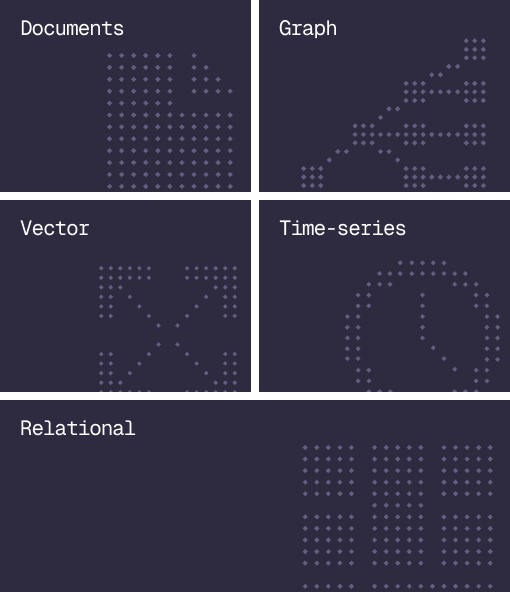
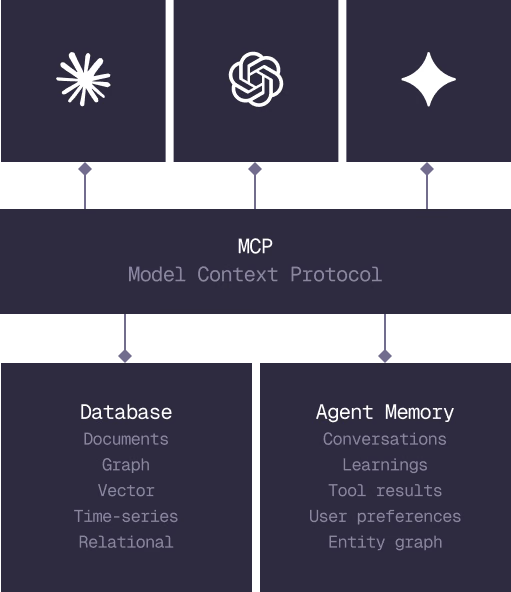
Aspire Comps moved the backend on to SurrealDB and consolidated the five services into one ACID engine. Notifications, campaigns and recommendations now run on the same database as the competition data, with one query language across all of it.
The migration moved data at 10,000 records a second with zero downtime, so competitions kept running while the platform changed underneath them. Search, permissions and event handling are built into SurrealDB, which removed the external tools that had provided each of them before.
Schemaless documents let the team try new competition formats without a migration, and live queries push changes to the app as they happen. High concurrency during a draw is handled by the engine, with no extra caching layer in front of it.
Results
Five services became one platform
The Firebase backend and the four services around it are gone, and one SurrealDB engine holds the data, the auth, the functions and the search.
Lower latency by design
Requests no longer chain across services, so the cold starts and dependency delays that slowed the user experience are gone with them.
Faster iteration
Schemaless documents and live queries mean a new feature or competition format ships without a schema migration first.
700,000 users on one stack
The platform serves 700,000 users from a single consolidated stack, with the room to keep growing.