This page shows the history that the Vulcan, Alberta demo gives to Agent Memory, and how it was prepared. The embedded page below draws 24 years of the article in three parts:
Edits per month. Each bar is one month, and the red part counts edits that a later edit reverted.
What the article claimed, and when. Each bar is a claim that one of the demo's questions asks about, with the dates it was on the page. Grey bars are claims that are no longer there, such as the nine grain elevators and the streets named after classical gods, both removed in August 2026 for being uncited. Select a claim to read it and the edit that removed it.
Today's article. Each sentence is shaded by how long its wording has stood. Sentences that have not changed for years are bold, and recent or often-changed ones are pale.
Best viewed full screen. Press Esc to come back to this page.
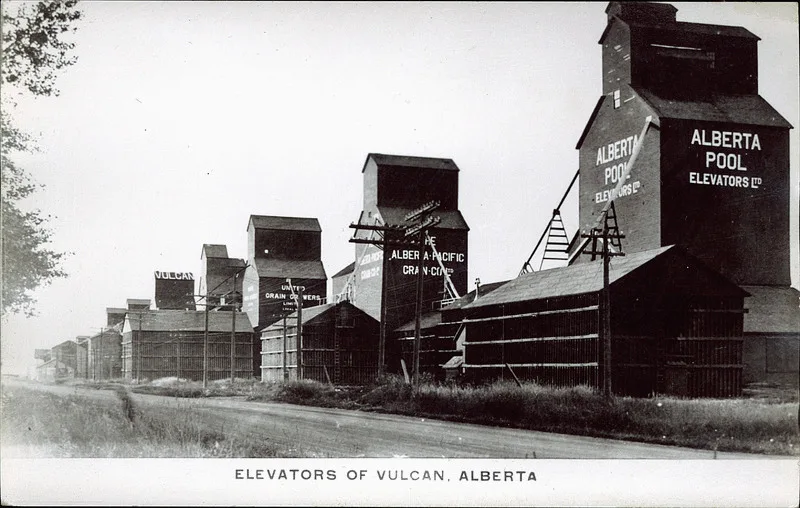
Grain elevators in Vulcan, on a postcard from after 1920. From 2011 the article said that Vulcan once had nine grain elevators, more than any other place west of Winnipeg. The claim was marked as needing a citation for the whole 15 years it was on the page, and it was removed in August 2026. Postcard from Peel's Prairie Provinces, University of Alberta Library, via Wikimedia Commons, CC BY 4.0.

How it was built
Fetch the history. The MediaWiki API returns every revision of the article with its text, its edit summary and its tags. The talk page's 20 revisions come the same way.
Leave out reverted edits. An edit that a later edit reverted is vandalism, a test or an unsourced addition that was removed within minutes. The 61 such revisions are not ingested, so the memory never holds them as facts. A revert is found in two ways: by the
mw-revertedtag, and by a later revision whose text is identical to the one before the edit. Vandalism that an editor corrected by hand, rather than reverted, stays in the memory as part of the history.Write each edit as a document. For every remaining revision, the document describes what the edit changed: the sentences added, removed or reworded, and whether a "citation needed" mark was added or removed. A document reads as a short report rather than as the whole article, so extraction works on the change itself.
Upload each document with its date. Each upload sets
observedAtto the revision's timestamp, so the memory places each fact at the time the article stated it rather than at the time of ingest. See Uploading documents for the metadata fields.Connect the agent. The agent connects to the memory through its MCP server, with the read tools only:
recall,context,reflectandinspect, so it cannot write to the memory or delete from it.
Editors are not named anywhere in the demo. The documents leave out usernames and IP addresses, and the agents' answers on the second page have any name they found in the history replaced with "an editor".
The MCP tools search the memory as it is now. They do not take an asOf time, so the agent answers questions about the past from the dated text of the edit documents. The REST API can read a value as of a given time and list an entity's history directly, as Temporal validity describes.
Using the same approach on another article
Any Wikipedia article works the same way, and a short article with a long history is the best start. Vulcan's article has 428 revisions, with claims added and removed over 24 years. Being more selective about which edits to include is recommended when ingesting an article with tens of thousands of revisions.
The text and history of every Wikipedia article are available under CC BY-SA 4.0. A page built from them takes the same licence and credits the article it came from.