In 1066 William, Duke of Normandy, won the Battle of Hastings and became king of a country he knew little about. Twenty years later, at Christmas 1085, he ordered his new kingdom surveyed: every holding, who held it before the Conquest and who held it now, what it was worth, and the ploughs, mills, woodland and pigs on it, down to the villagers, smallholders and slaves who worked it. The Anglo-Saxon Chronicle complained that not one ox, cow or pig was left out. The result was Domesday Book, named after the Day of Judgement because there was no appeal against what it recorded. Nothing like it was attempted again for about eight centuries: the first national census counted people in 1801, and the 1873 Return of Owners of Land, which counted land, was nicknamed the Modern Domesday.
This demo ingests the 52 entries of that survey for South Erpingham, a hundred in Norfolk, and asks SurrealDB Agent Memory questions that no single entry answers. Each entry is an inventory of one holding: who held it before and after the Norman Conquest, what it was worth, and what was on it. The survey never states a relationship, so who was bound to whom has to be assembled from many entries. The answers below are shown as chat returned them, with every citation linked to its entry and a note on how each answer was checked.
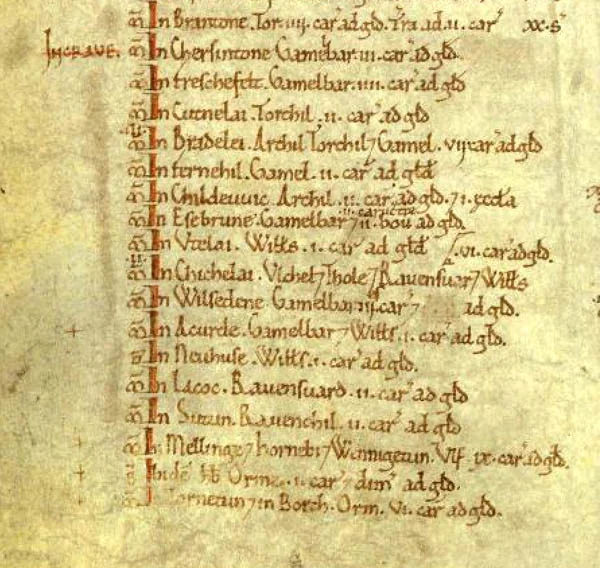
Great Domesday, folio 301v, for Craven in Yorkshire. Each line gives a place, the man who held it and its assessment, such as In Chersintone Gamelbar iii car ad gld: "in Chersintone, Gamelbar, 3 carucates for geld". The Norfolk entries this demo uses are in Little Domesday, the more detailed second volume, and follow the same pattern at greater length. Public domain, The National Archives via Wikimedia Commons.

As you go through the answers, note the following
The same person is recognised across entries. No entry carries an identifier, so the William of Warenne in one village and the one in another are joined by the memory, not by the data.
One answer describes two periods. "Who was bound to whom" sets the men commended to earls and abbeys in 1066 beside the chains of tenancy that end in the King in 1086.
The wording of a question matters. The survey records mills for grinding corn and never uses the word bread, so the same records answer one phrasing of the question and not the other.
Each answer was checked against figures computed from the same data. The panel beside an answer says what was right, what was missed and what was wrong.
The last question is a control. Gaywood is a real Domesday manor in another hundred, which was never ingested. A model that knows Domesday could have answered from memory, and the answer declines.
What went in
The data is the Domesday databases compiled by J.J.N. Palmer and team, deposited at the University of Hull. Each entry for the hundred was written as a short prose record, the way a surveyor would report it, ending with its reference in the printed edition:
Scottow, in the hundred of South Erpingham in Norfolk.

Before the Conquest, in King Edward's time: one free man held land assessed at 0.10 carucates for geld.

In 1086: Ribald brother of Count Alan holds it of Count Alan, who holds of the King, worth £1 4s.

The survey records a mill for grinding corn, 6 acres of meadow and woodland for 20 pigs here.

Domesday Book, Norfolk 4,36.
Nothing else was supplied: no list of people, no table of holdings, and no links between entries.
What came back
| Question | Result |
|---|---|
| Who was bound to whom | Every tie named is in an entry: 21 commendations in 1066 and 11 sub-tenancies in 1086. Some ties are missed. |
| The wealthiest | The right landholder, King William, with a total of £41 8s against £56 16s 7d over all 52 entries. |
| A mill, in 1086 terms | 15 of the 28 villages with a mill, and none without one. |
| Bread, in modern terms | Declined, since the records say mill and not bread. |
| A place not ingested | Declined, with no citations. |
Nothing in any answer was invented. What varies is how much of the corpus an answer saw. A total needs every record that contributes to it, and a chat answer is written from the records retrieval returns for it, so the wealth total comes out low while the ranking holds, because the King leads by a wide margin. Set breadth to match the question shows how to count a total in your own code, and Bridge period vocabulary and modern questions covers the bread question.
From answers to a draft
The tie between commendation in 1066 and tenancy in 1086 is the kind of claim a historian would build a paper around, and here each part of it arrives with the entries that support it. Reflection writes that kind of synthesis across many records. Treat the result as a draft for someone who knows the period to check, not as a finding.
Query the records yourself
The embed below loads what the Agent Memory API returned for this demo into a SurrealDB instance in your browser, as three tables: entity, attribute and relation. This is the API's response shape, not the data Agent Memory holds internally, which also includes embeddings, source chunks and indexes. Each attribute and relation names the document it was extracted from in source. Edit the query and run it again, or download the file from datasets.surrealdb.com.
The query below follows the chains of tenancy in 1086 that stop short of the King: a tenant holding of a lord who holds of the King in turn. The King appears under two names, King and the King, because extraction created an entity for each, which the query allows for.
Related pages
Historical and archaeological data: the method behind this demo, including the controls that show an answer came from the corpus.
Pompeii election notices: the same approach on a corpus where allegiance is stated outright.