SurrealDB Agent Memory uses two complementary mechanisms:
Contexts - hard isolation between separate products or deployments (each with its own database and keys).
Scope - tags on memory records that partition data within a Context (org, user, project, and so on).
Scope is not the same as permissions. Scope says which bucket a fact belongs to. Principals and grants say who may read or write at which scope paths. Together they define what each caller is allowed to see. A principal may delegate grants to another principal, but only up to what they already hold - you cannot grant access you do not have.
Contexts
A Context is the fundamental unit of isolation. Each Context maps to its own SurrealDB (namespace, database) pair holding documents, turns, entities, traces, and configuration. Nothing crosses Context boundaries.
Typical reasons for separate Contexts:
Separate products with no shared memory
Distinct business units
Test versus production environments
Context or scope?
Use scope when records belong to the same product world and you only need to partition them (by user, project, tenant path, time folder, and so on). Grants then decide who sees which paths.
Use a new Context when isolation must be absolute, namely when nothing from A should ever appear in B’s /query, /chat, or profile, even by accident.
| Prefer… | When… |
|---|---|
| Scopes | Same app, same “who is speaking,” shared models and config; you need folders (org/user/project) or temporary lenses |
| New Context | Different products, environments (staging vs prod), or personas that must not share a profile |
| New Context | Memory has become polluted (operator chat mixed with character memory, eval probes drowning testimony) and forgetting individual paths is harder than starting clean |
| New Context | You need a clean eval / demo run with reproducible prior-memory seeds |
Scopes do not give you a second profile or a second response-cache. Chat turns, instructions, and consolidation still live in one Context-wide substrate. If Workbench answers as the wrong persona, or retrieval is dominated by earlier probe denials, registering another scope path will not fix that - create a fresh Context (and new API keys), re-seed what you still want, and leave the old Context as a regression artefact if useful.
A practical rule: scope partitions data; a Context partitions worlds. When in doubt for demos and product testing, prefer a new Context over trying to “scope away” cross-talk.
Contexts are created in SurrealDB Studio with Deploy new context (see Agent Memory on SurrealDB Cloud), and API keys are created in the Context's API keys view.
API keys are issued per Context - a key for acme-prod cannot access another Context.
Scope tags (data partitioning)
Within a Context, memory records carry scope as an OR of conjunctive clauses - each clause names one or more hierarchical scope paths that must all apply together (AND within the clause, OR across clauses). Typical single-owner facts use one clause; co-ownership uses multiple clauses so more than one principal can read the same record.
You still choose dimensions that match your app: org, user, team, project, region, env, and so on - expressed as paths like org/acme/user/alice/.
How visibility works
On each read, SurrealDB Agent Memory resolves your grant into the scope nodes you may cover, then finds which scope-set clauses on each record are fully satisfied. A record is visible when at least one clause matches (fail-closed: empty or unmatched scope sees nothing).
For the common case - a single clause with one or two tags - behaviour matches intuitive subset semantics:
| Record clause (simplified) | Query / grant covers | Visible? |
|---|---|---|
{org/acme} only | {org/acme, user/alice} | Yes - org-wide fact visible in user queries |
{org/acme, user/alice} | {org/acme} only | No - user-specific fact hidden from org-only reads |
{org/acme, user/alice} | {org/acme, user/alice} | Yes |
{org/other} | {org/acme, user/alice} | No |
Co-ownership: a document deduplicated across two uploaders may carry two clauses - one per owner - so both can read the same content-addressed file without a separate copy.
The figure below shows one caller's grant on a scope tree, which records it makes visible, and how a lens filters them.
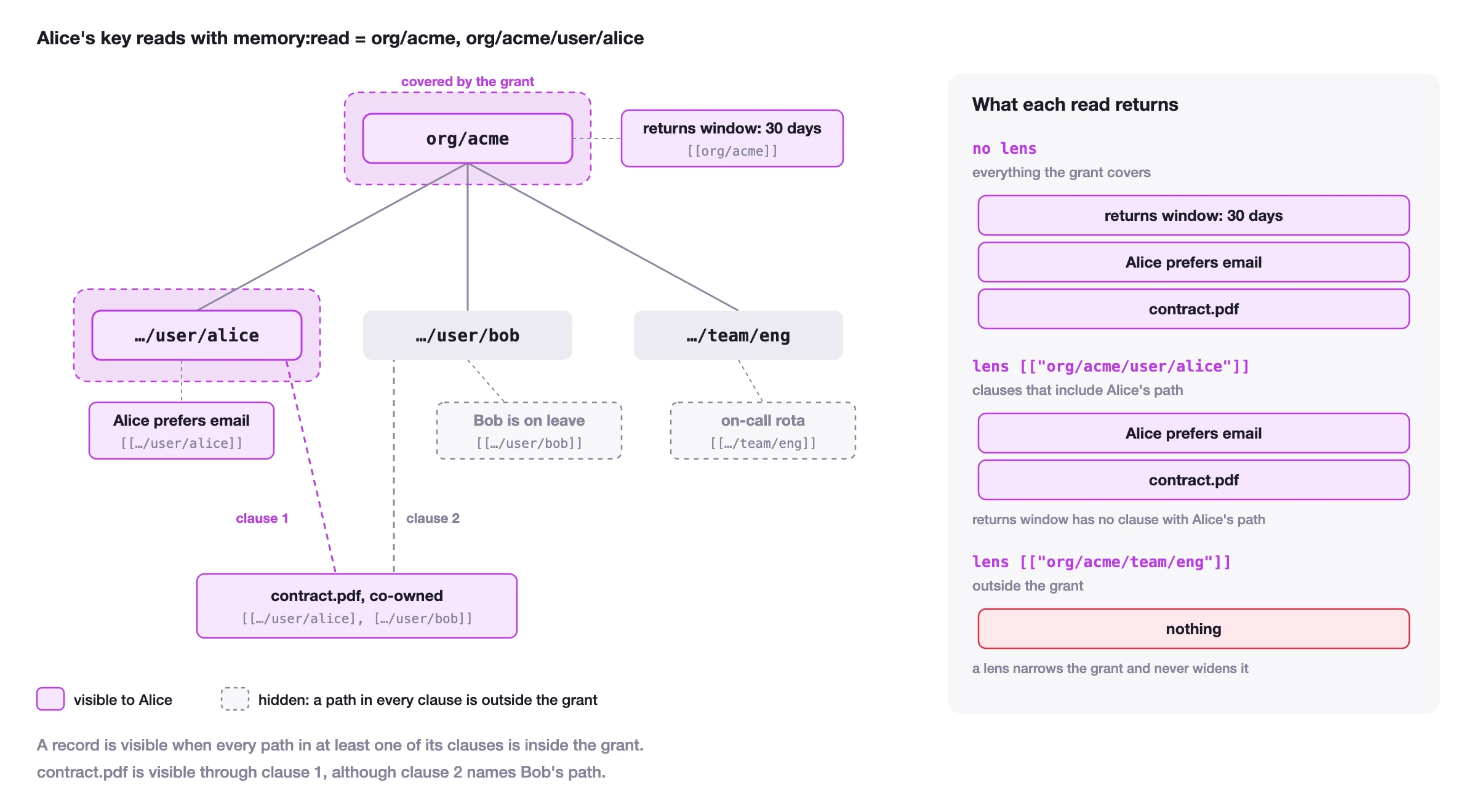
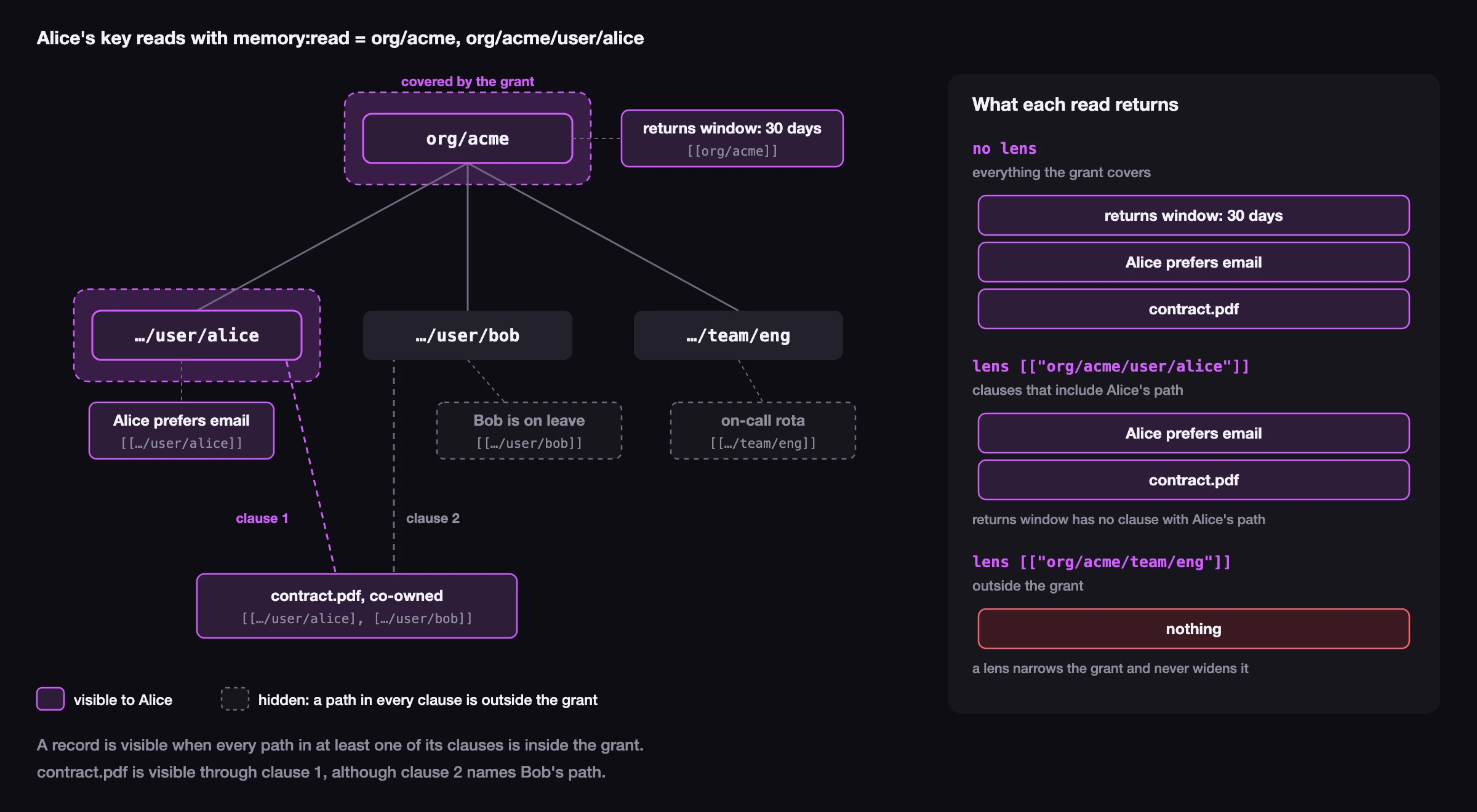
Org-wide facts appear in user-level queries; user-specific facts do not appear in org-only queries.
Wire format (ScopeSets)
On the wire, scope selectors use disjunctive normal form - an OR of conjunctive clauses:
| Intent | scopes / lens value |
|---|---|
| Tag or read at one path | [["org/acme/user/alice"]] - or a bare string "org/acme/user/alice" (accepted as a singleton clause) |
| Co-own across two owners (OR) | [["org/acme/user/alice"], ["org/acme/user/bob"]] |
| Require two paths together (AND) | [["org/acme", "org/acme/team/eng"]] |
Writes use
scopeson facts, sessions, uploads, and MCP tools. The legacy field namescopeis still accepted as an alias.Reads use
lenson/query,/context, and MCP recall - same DNF shape, but the lens filters by involvement within your grant; it never widens access.
Breaking change (pre-GA): a flat two-element array such as ["org/acme", "project/support"] now means OR (org/acme or project/support), not AND. To express AND, nest the paths in one inner array: [["org/acme", "project/support"]].
Example queries
As a specific user (read lens):
{ "lens": [["org/acme/user/alice"]] }Matches records with a clause that includes org/acme/user/alice. An org-wide fact tagged only org/acme does not include that path, so it is filtered out; use [["org/acme/user/alice"], ["org/acme"]] to return both, or omit the lens to return everything your grant covers.
At org level:
{ "lens": [["org/acme"]] }Matches records with a clause that includes org/acme. Alice's records tagged only org/acme/user/alice do not match, even when your grant covers her path; use org/acme/* in the lens to include the subtree.
Register paths before first use: surreal memory scopes create org/acme/user/alice.
Default write region
When a write omits an explicit scopes selector - Workbench chat, a document upload without metadata scopes, or remember without --scope - SurrealDB Agent Memory tags the new records with the caller's resolved memory:write region (the scope paths your key or brokered token already covers).
Those facts are real and queryable immediately. The Scopes UI lists registered vocabulary paths; an empty tree does not mean no memory exists yet - it means you have not registered named paths for navigation. Use Lookup or GET /profile to inspect what was stored under your principal's region, then register paths such as org/acme/user/alice when you want hierarchical partitioning.
On SurrealDB Studio, a new context's Overview count of one scope is usually that root write region. Register additional paths (for example surrealdb/employee_1 and surrealdb/employee_2) when you want explicit folders for grants and uploads - see SurrealDB Agent Memory on SurrealDB Cloud.
Tombstone vs erase
Two destructive operations sound similar but differ:
| Operation | What it affects | Reversible? |
|---|---|---|
Tombstone scope node (scope:delete, Scopes UI) | The folder entry in the scope vocabulary | Soft-delete - node marked tombstoned; facts may still exist until erased separately |
Scoped forget (POST /scopes/forget) | All facts tagged under a scope subtree | No - permanent erasure for compliance |
See Forgetting memories.
Permissions and delegation
Scope tags partition data. Grants partition access. Four things sit between a request and a stored fact, and each answers a different question:
| Term | Answers | Changes when |
|---|---|---|
| API key | Which credential is calling, and how narrow is it? | You rotate, revoke, or attenuate a credential |
| Principal | Which identity does that key act as? | Rarely - it is the identity recorded on every write |
| Grants | Which verbs may that identity use, and where? | You widen or narrow access |
| Scope | Where does the knowledge live? | You register new paths |
Every key is bound to exactly one principal - there are no unbound keys. The key authenticates, the principal supplies the grants, and the grants name scope paths. So a write resolves as key → principal → grants → scope, and the fact is tagged with the scope region that chain lands on.
The figure below follows that chain for one principal with three keys.
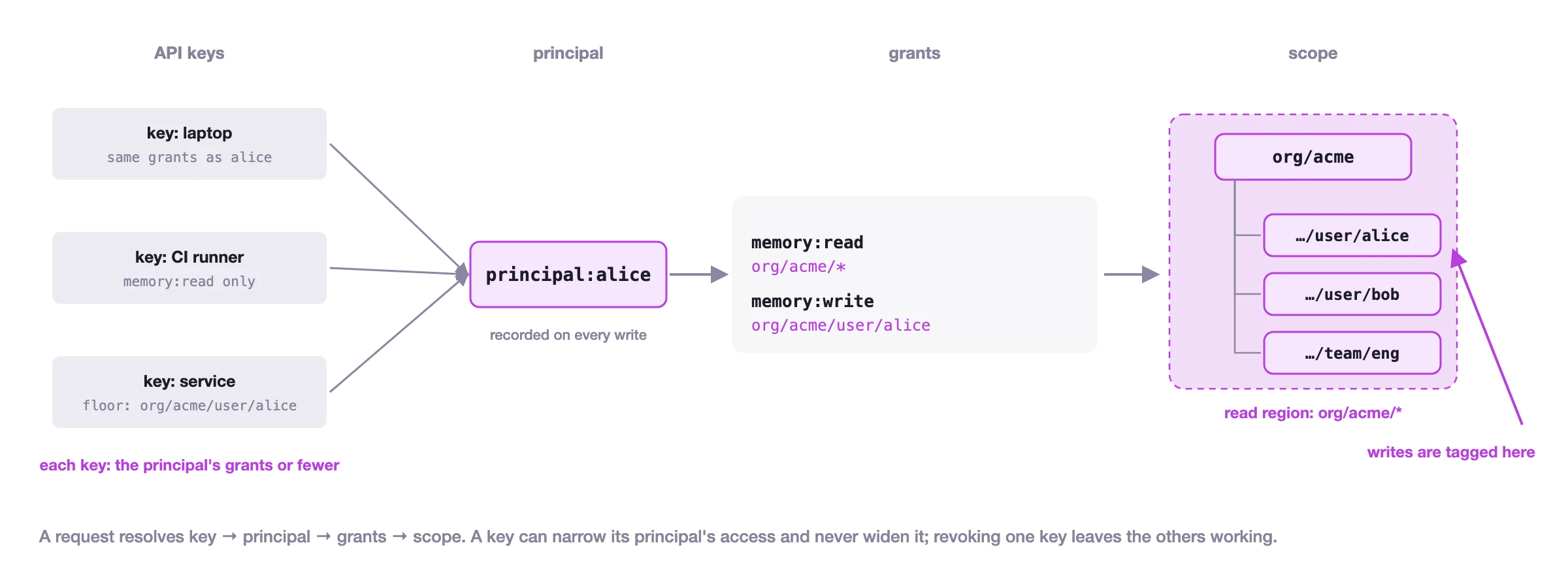
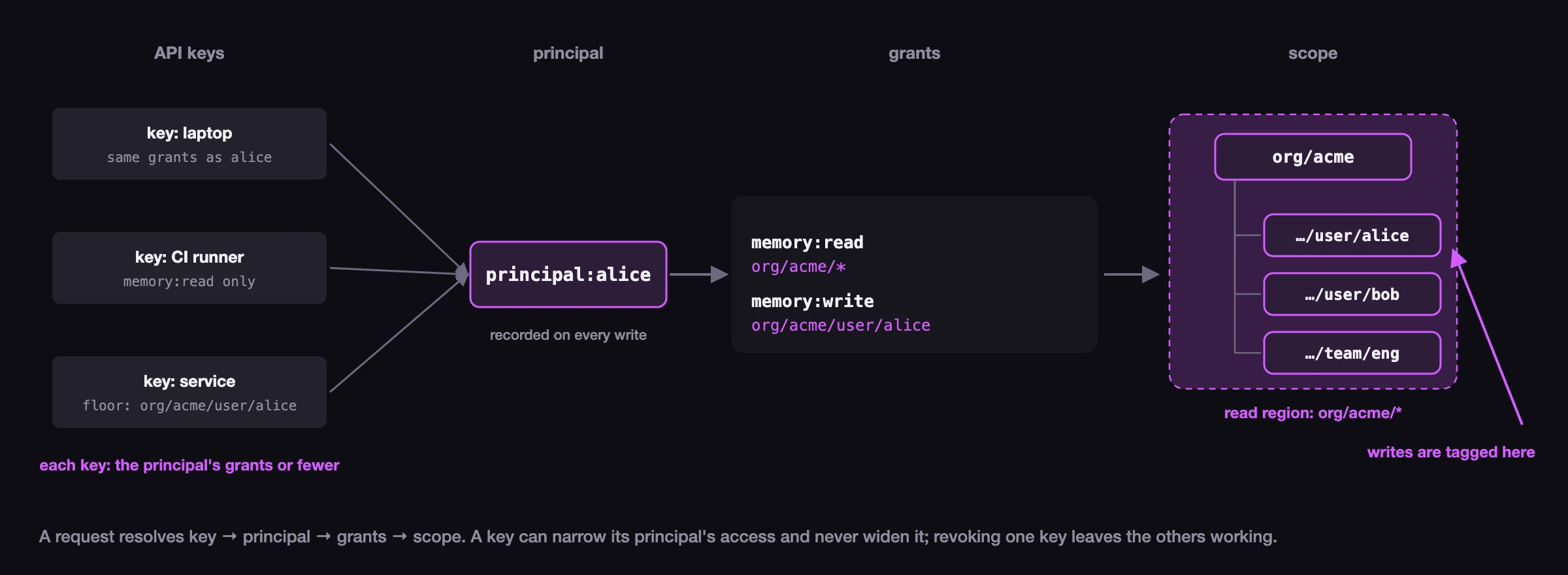
A key can carry less access than the principal it acts as, never more. Key grants must be a subset of the bound principal's on every mint path, and a key's scope floor sets the minimum paths its requests must include: a key floored at org/acme cannot ask about org/beta, whatever the principal is allowed.
Keys and principals are separate for a practical reason: they change at different rates. One principal can hold several keys - a laptop, a CI runner, a service. Revoke one key and the others keep working, with no change to access. Widen a principal's grants and every key it holds follows, with no re-issue.
A principal receives grant verbs (
memory:read,memory:write,grant:manage, …) on scope paths.Granting to someone else can only convey part or all of what you already have - not broader access.
API keys bind a principal to a scope floor; the server clamps requests that try to escalate.
The principal - not the key - is what provenance records, which is why
principal:ids appear throughout stored facts and request logs.
Exact node or subtree
A grant names either one node or a node and everything under it. The trailing /* is what separates them, and paths are hierarchical only where a pattern says so:
| Pattern | Covers | Does not cover |
|---|---|---|
org/acme | that node alone | org/acme/team/eng |
org/acme/* | that node and every descendant | org/beta |
* or /* | every scope in the Context | - |
A * anywhere other than the end is rejected.
The figure below compares an exact grant, a subtree grant, and the write-without-read-back case the warning describes.
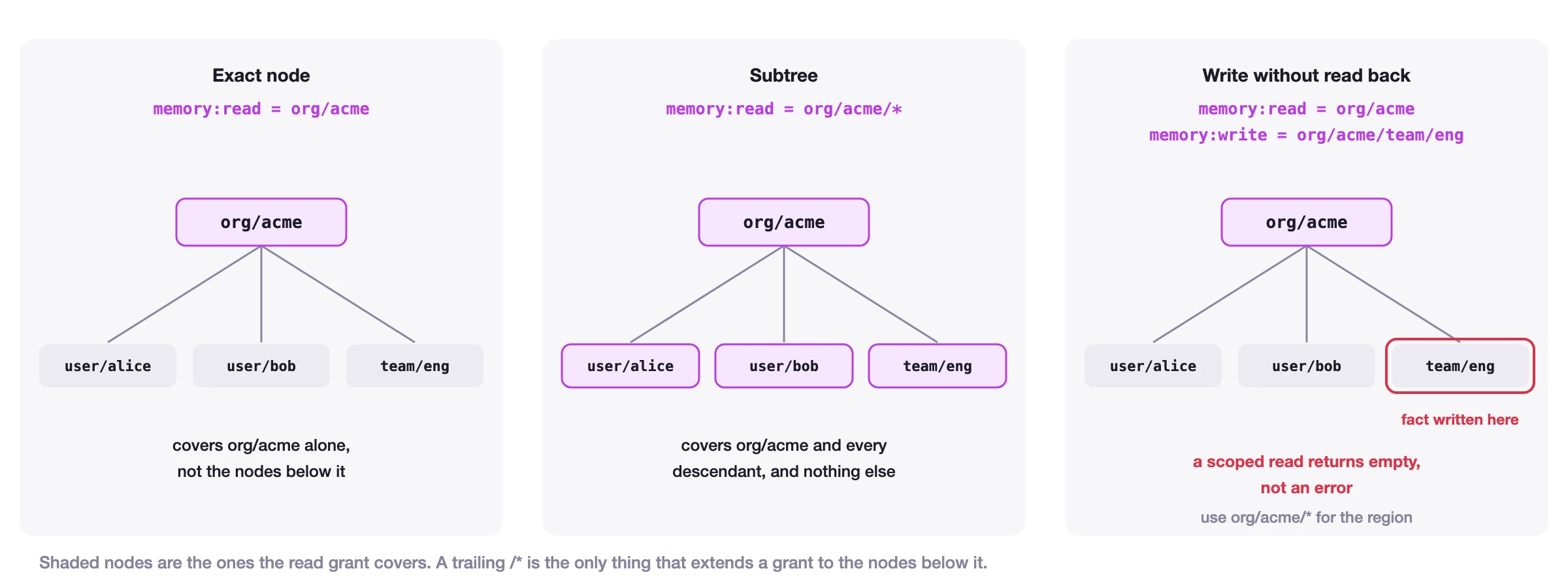
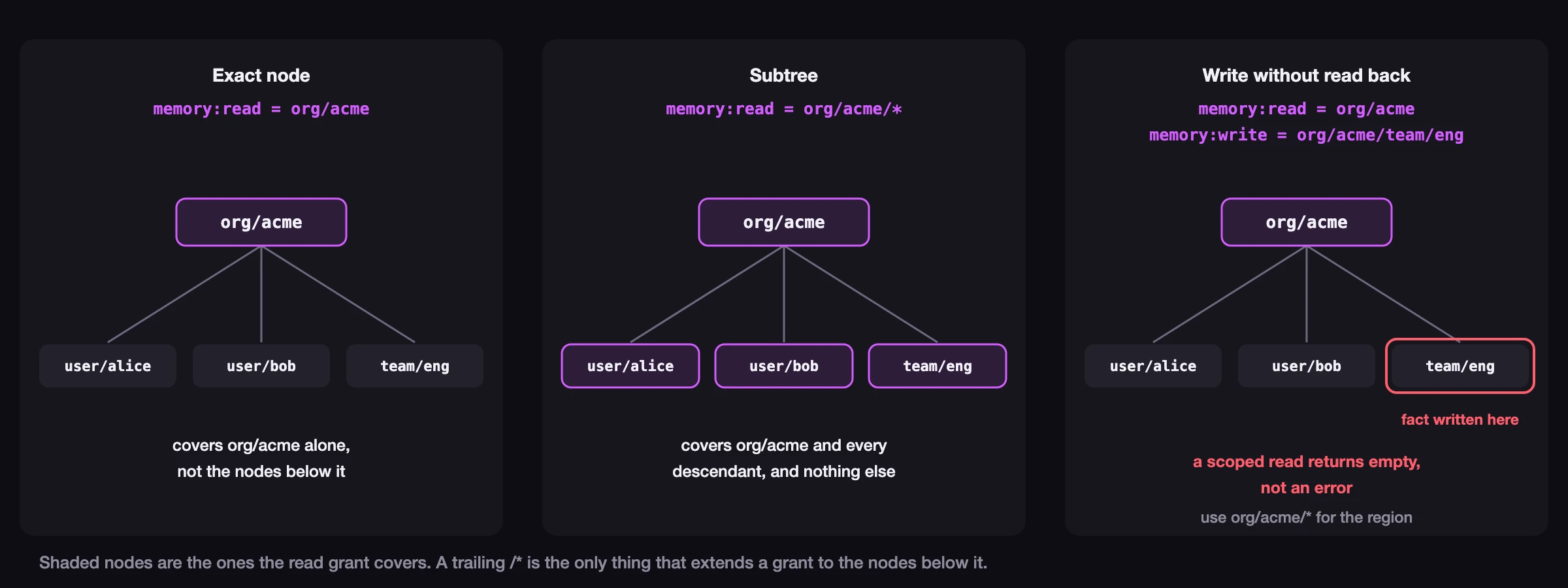
A grant on a parent alone does not cover its children. memory:read=org/acme plus memory:write=org/acme/team/eng writes records the same principal cannot read back, and the symptom is quiet: scoped reads return empty, not refused, so a client that polls for its own writes waits instead of failing. Use org/acme/* when you mean the region.
Register a scope path with surreal memory scopes create before a write targets it. Creating paths is its own verb (scope:create), so the identity that registers the vocabulary is often not the one that writes into it.
See Surface, models, and security for how keys and grants are enforced at the request surface.
Acting on behalf of another principal
A caller such as a gateway or a supervisor agent can act for one user by sending X-Spectron-On-Behalf-Of: <principal_id> on a REST request, an /mcp call or a document upload. The request then reads and writes as that principal, with the intersection of the caller's key, the caller's grants and the target's grants, so delegation never widens access. It goes one level deep: the target cannot pass the request on to a third principal.
A principal accepts delegation only when its delegation_allowed flag is set. The flag is off by default, and is set when the principal is created or updated in SurrealDB Studio or through the SurrealDB Cloud API, or with surreal memory principals create --allow-delegation. A request for a principal without the flag returns 403, and one for an unknown principal returns 404.
Geographic filters
Geography is not part of scope. Scope paths are names only, and a scope grant never involves a location. To limit a read by place, /query takes a separate location filter that applies to entity.location and to the source location of conversational passages: either {"near": {"lat": 51.5, "lng": -0.12, "radiusKm": 25}} or {"within": "<WKT polygon>"}. The filter only narrows results inside the caller's read region, and works alongside the semantic and graph signals in the ranker.
Use cases
Multi-tenancy: One Context, one API key per customer org scoped to org/<id>/.
Per-user isolation: Tag interactions with user/<id>/ so personal memory stays private unless the query includes that user path.
Shared org knowledge: Tag policies with org/acme/ only; tag personal notes with org/acme/user/alice/.
Project context: Add a project/… segment so project-specific instructions surface only in that project’s scope.
Labels, lens, and scope views (reads)
Recall and context endpoints accept optional parameters beyond flat scope tags:
labels- descriptivekey=valuetags (for examplesubject=alice) that filter results within what scope and permissions already allow. Labels help you find facts about something; they do not grant access by themselves.lens- optional hierarchical scope paths that filter by involvement within your grant. A lens ofregion/eureturns every readable clause that includeseu- for example both{eu}and{eu, macbook}- rather than shrinking your access region to exact{eu}matches only.scopeView- controls how broadly results are folded within the caller’s grant:strict(default) - the caller’s own read region only.crossTeam- cross-principal shared reads where grants allow; resolves likestrict.merged- same-fact records at narrower scopes with provenance preserved; resolves likestrict.
None of these widen past a principal’s grant. See REST API for /query and /context request fields.