Deploy an instance from the deploy page in SurrealDB Studio. The page holds every setting in one form, from the name and region to checkout.
Deployment takes a few minutes. You can change most settings afterwards, but not the region, whether the instance runs on a single node or a cluster, or the name of a dedicated instance.
Before you begin
You need:
An account. See Accounts and sign-in.
An organisation to hold the instance. See Organisations.
1. Open the deploy page
Open the organisation that will hold the instance.
Go to Instances.
Select Deploy new instance.
2. Enter the instance details
Name identifies the instance in the organisation. The name of a dedicated instance cannot be changed later, so use a name that stays meaningful: api-production, api-staging, or analytics-eu. An Earth instance can be renamed later from the General tab of its settings.
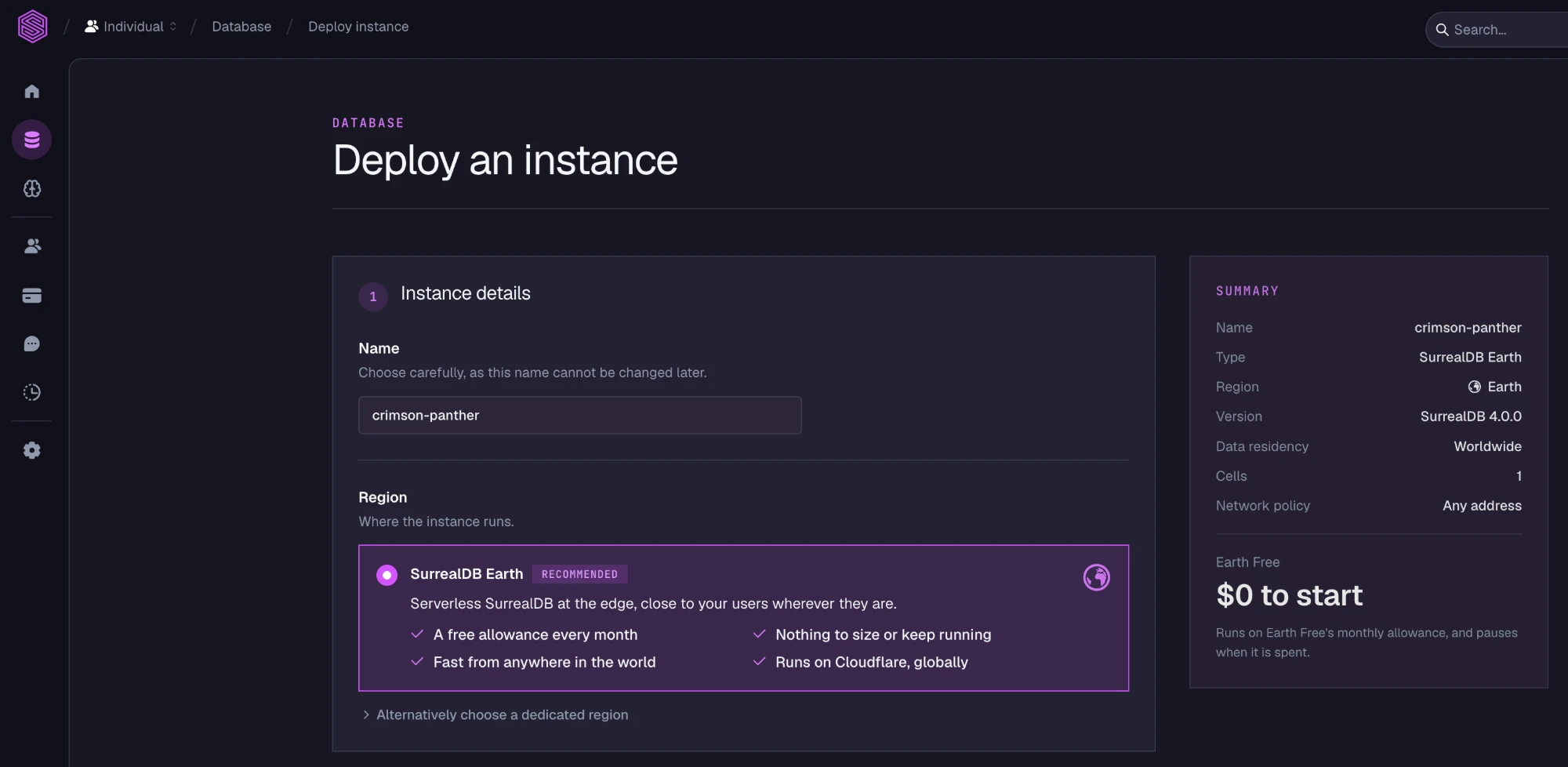
Region sets where the instance runs and where its data resides. You cannot change it later either.
SurrealDB Earth is selected by default. It is serverless SurrealDB on the Cloudflare network, with nothing to size, and its settings are different from those of a dedicated instance. See Deploy an Earth instance.
To run the instance on its own nodes, in the cloud provider of a region, select Alternatively choose a dedicated region and choose the region. Deploy into the same region as your application stack where you can.
Dedicated instances are currently available in:
| Provider | Region |
|---|---|
| AWS | US East (N. Virginia) |
| AWS | US West (Oregon) |
| AWS | Europe (Ireland) |
| AWS | AP South (Mumbai) |
| Azure | Europe (Germany) |
| Azure | US East 2 (Virginia) |
| Azure | South America (Brazil) |
The region selector shows what is available to your organisation, and that list is the authoritative one. AWS PrivateLink is offered in a subset of AWS regions.
The rest of this page covers a dedicated instance.
3. Choose the node count
Node count sets how many nodes the instance runs on.
| Node count | Topology | How it scales |
|---|---|---|
| 1 | A single node, the Start plan | Vertically only |
| 3 or more | A fault-tolerant cluster, the Scale plan | Vertically and horizontally |
A cluster needs at least three nodes, so the choice goes from one node to three. Studio currently deploys clusters of up to five nodes. More nodes add capacity, and keep the instance available when a node fails. See High availability.
The count fixes the topology of the instance. To move a workload from a single node to a cluster, deploy a new instance with three or more nodes, then restore a backup or import an export into it.
4. Choose an instance type
The instance type sets the vCPU and the memory of each node, and how large its storage can grow. Select a workload, then a size within it.
| Workload | Behaviour | Suited to |
|---|---|---|
| Burstable (Development) | Full CPU in short bursts, not guaranteed under sustained load | Prototypes, testing and staging |
| General Purpose (Production) | Consistent CPU under sustained load, with twice the memory for each vCPU | Live applications |
The sizes on offer depend on the node count. You can change the instance type later from the instance's settings. See Scaling.
5. Choose the version
Version sets the SurrealDB release the instance starts on. Take the latest stable release unless you have a reason not to. You can upgrade later from Settings → Version. See Versions and upgrades.
6. Set the storage capacity
Storage is provisioned per instance, and the range on offer depends on the instance type. Choose the instance type first: the storage setting then shows how much the type includes and how far it can grow. On a single node, the range grows with the memory of the type. See Storage limits on Start.
You can increase storage later but never decrease it. Start close to what you need rather than over-provisioning.
An organisation with AWS PrivateLink enabled also chooses whether the instance takes Public traffic, Private traffic, or both.
7. Review and deploy
The Checkout section summarises the instance: its name, type, region, version, node count, size and storage.
Check the summary.
Add a payment method if the organisation does not have one yet. Dedicated instances are billed monthly from the moment they run. An organisation with a card on file can select Change card to use another one. See Billing.
Select Deploy instance.
The instance is provisioned within a few minutes.
8. Verify the instance
Go to Instances in the organisation.
Confirm the new instance appears in the list.
Open the instance and check that the dashboard reports the version, region, and instance type you chose.
Connect to the instance and run a query.
A new instance has no namespace or database yet. Create both before you run a query. See Connect via SurrealDB Studio.
Restore a backup into a new instance
A restore creates a new instance from a backup snapshot and never overwrites the original. Select Create instance on a backup in the source instance's settings, which opens the deploy page with that backup selected. The new instance must be in the same region as the source, and its storage must be at least as large.
Deploying from the command line
surreal cloud instance create performs the same deploy, which is what you want in CI or in a provisioning script. See surreal cloud instances.
Next steps
Connect to an instance: SurrealDB Studio, the CLI, SDKs, and HTTP.
Configure an instance: capabilities, compute, and storage.